Bitcoin, as the world’s most widely-adopted cryptocurrency, is a dependable store of value and an attractive investment asset with more long-term appreciation potential than holding cash. Since its inception over a decade ago, Bitcoin has emerged as a significant addition to the global financial system, with characteristics that are useful to both individuals and institutions. MicroStrategy has recognized Bitcoin as a legitimate investment asset that can be superior to cash and accordingly has made Bitcoin the principal holding in its treasury reserve strategy. Michael Saylor
5.2.1 Introduction
While bitcoin may not be a conventional holding among corporate treasurers, a greater understanding of bitcoin may help to explain why corporate treasurers of large, publicly traded companies and others have started to embrace it in recent years. Many of bitcoin’s properties, such as a maximum supply of 21 million tokens and verifiable scarcity on a public blockchain, make it an attractive store of value. This critical segment of a portfolio could potentially be a valuable hedge against growing fiscal deficits, currency debasement, and geopolitical risks. As corporate treasurers grapple with new economic headwinds, bitcoin’s unique properties have acted as tailwinds.
Traditionally, corporate treasuries have managed cash conservatively by allocating most of the capital to what are often perceived as low-risk assets (e.g., bank deposits, money market funds, treasury bills, commercial paper, and repurchase agreements). However, uncertain economic factors including inflation, interest rates, and heightened geopolitical risks may be causing corporations to reconsider the viability of such strategies. Adopting bitcoin as a treasury reserve asset can help to address these risks.
5.2.2 Why Bitcoin ?
Money is an asset or set of assets that people can use to buy goods or services, pay debts or store value, so it includes one or more of these properties:
Unit of account: Money is used to set the price of good and services
Medium of exchange: Money can be used to facilitate trade of goods and services
Store of value: Value provided in the form of goods or services provided to the market by a company or individual can be stored for later use
Not all assets need to provide all three of these properties – rare art or an expensive property can act as a store of value for example, but cannot easily be exchanged in the market.
Bitcoin is evolving to potentially meet all three of these functions, but the focus here is how it can be used as a store of value in a treasury by any company large or small. It has excelled at this function since inception, and this is now driving the adoption of it as a treasury asset for individuals, corporations and even countries, as the quote above describes.
Countries such as El Salvador and Bhutan have been purchasing or mining Bitcoin for some time and adding it to their reserves, but the concept of nation state Bitcoin reserves received global publicity when the US presidential candidate announced a plan of creating a national strategic Bitcoin reserve.
Companies have also been creating their own bitcoin treasury reserves since 2020 when both Square and MicroStrategy announced their plans to do so, and smaller companies have been following their lead.
We really felt we were on a $500M melting ice cube, once the real yield on our treasury got to more than negative 10%, we realized that everything we are doing on P&L is irrelevant. Michael Saylor
Creating a Bitcoin treasury has solved the problem that MicroStrategy had and has helped it to increase value to shareholders since it implemented this strategy in 2020. This approach can provide similar benefits to companies large and small in any geographic location.
Why would companies and even countries benefit from a Bitcoin treasury? Cash in the bank, which depreciates in value due to money creation, has not been a good store of value. Companies have resorted to using that cash to gain growth via acquisitions, or to give it back to shareholders in the form of stock buybacks.
Companies, governments as well as individuals are unable to store value in fiat currency, which drives them to look for alternatives, such as bonds, property or hard assets. Not all of these can easily be added to a treasury.
Bitcoin represents a solution to digital scarcity and is in the process of draining the monetary premium from such assets. This has helped it to become the best performing asset since its inception, and is expected to continue outperforming other assets going forward.
With the advent of new accounting rules, every fiduciary now has a responsibility to understand bitcoin, to see if it has a place in the treasury, and to understand the risks of adoption or non-adoption to the business.
5.2.3 Companies and Organizations Already Adopting Bitcoin
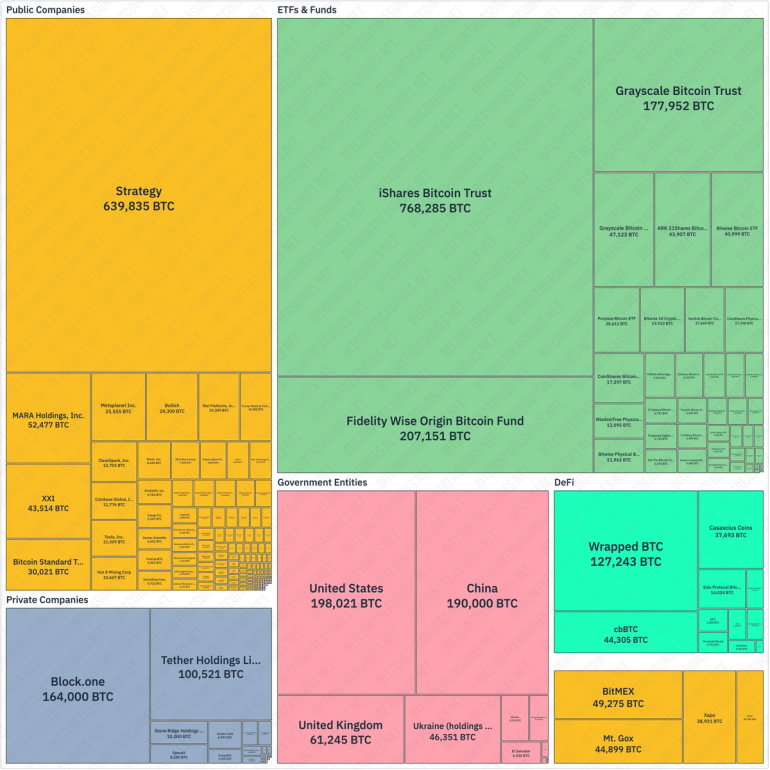
Bitcointreasuries maintains a list of all known major Bitcoin holders including private and public companies, Governments and investment funds.
Snapshot Q3 2025 of bitcointreasuries.net
As the diagram shows, there are many companies that have adopted Bitcoin, not always as a part of their treasury strategy. With the exception of MicroStrategy and Tesla, the larger holders have been companies involved with the Bitcoin industry so this might be expected. However, as the concept and the benefits have become better understood, companies outside the Bitcoin space have also started to adopt it.
Square
On October 7, 2020, Square, Inc. purchased approximately 4,709 bitcoins at an aggregate purchase price of $50 million. Square has been a leader in the bitcoin space since 2018 through our Cash App product, which provides customers the ability to buy and sell bitcoin. As believers in bitcoin’s potential for continued future growth, the company formed Square Crypto, an independent team solely focused on contributing to bitcoin open-source work for the benefit of all. Square also recently launched the Cryptocurrency Open Patent Alliance (COPA), a non-profit organization encouraging crypto innovation, opening access to patented crypto inventions, and helping companies and individuals defend themselves against patent aggressors.
Elon Musk - Tesla and Space X
Tesla's foray into Bitcoin began in February 2021 when the firm invested $1.5 billion. The firm said the bitcoin purchase was to help further diversify and maximize returns on its cash. Tesla stated that it will start accepting payments in Bitcoin in exchange for its products, subject to applicable laws. Elon Musk also revealed SpaceX’s Bitcoin holdings in 2021 at “The B Word” online conference. “I do own Bitcoin, Tesla owns Bitcoin, SpaceX owns Bitcoin,” Musk stated.
Recent on-chain analysis indicated as of Q4 2024 that the combined holdings of the companies was 19,788 Bitcoin.
As of late 2024, shareholders of other large companies including Microsoft and Amazon have been considering proposals for a Bitcoin treasury, so the momentum is growing.
Tahini’s
One of the owners of Tahini’s, a restaurant chain based in Canada, was already heavily involved in Bitcoin when MicroStrategy announced its plans for a Bitcoin Treasury and the company decided to follow suit, putting all non-essential (6 months working capital) into Bitcoin. It has held and continued to add to its reserve through the 2021 peak and back down, advocating that any business adopting this approach must take at least a four-year view.
In the four years since adopting this strategy, the chain has outperformed the majority of Wall Street in terms of returns. By installing Bitcoin ATMs and running Bitcoin Meetups, the business has also built up a loyal following of Bitcoiners.
The main problem that we have right now is that dollars are devaluating. Central banks will say inflation is only 5%. But that really depends on what you want to buy. Poultry is up 45%, beef is up 25%, imported goods and spices are up 65%, oils are up 110%, since March 2020, when the pandemic was accelerating. So it made sense to put our money into bitcoin and that will outstrip any inflation rates we see for the coming decade. Tahini Owner
Nation state adoption
As the diagram also shows, countries are now holding Bitcoin, often as a result of asset seizure, more surreptitious means such as mining or via sovereign wealth funds, and in the case of El Salvador as a deliberate policy.
El Salvador
In 2019, a group of cryptocurrency advocates and local community members in the small coastal town of El Zonte, El Salvador, set out to create a thriving, Bitcoin-based economy within their community. By educating residents on the benefits of Bitcoin, providing the necessary infrastructure and tools for its adoption, and incentivizing its use through a variety of initiatives, the Bitcoin Beach project quickly gained traction, transforming El Zonte into a vibrant hub of Bitcoin activity.
The success of Bitcoin Beach caught the attention of El Salvador’s president, Nayib Bukele, who recognized the transformative potential of cryptocurrency to address some of the country’s most pressing economic and social challenges. Inspired by the grassroots initiative, Bukele began to explore ways in which the Salvadoran government could further embrace and promote the use of Bitcoin nationwide.
In June 2021, Bukele made the bold announcement that El Salvador would become the first country in the world to adopt Bitcoin as legal tender, alongside the US dollar.
This has not only provided Salvadorans with a new, innovative financial tool but has also positioned the country as a global hub for cryptocurrency adoption and innovation.
More recently, Bukele has been meeting with Javier Milei of Argentina to discuss collaboration across Latin America for digital asset development. The country has been purchasing one bitcoin a day since the adoption of bitcoin as a reserve asset and legal currency, an investment that has been paying off so far.
United States of America
In Q3 2024, the Trump administration made a groundbreaking announcement in Nashville, revealing plans to allocate a portion of the US Treasury’s reserves to Bitcoin. The move aimed to diversify the nation’s asset base and harness the perceived benefits of digital assets. After his successful election campaign, the strategic Bitcoin reserve is expected to become US Government policy.
Several US States have subsequently announced similar plans to create strategic Bitcoin reserves, which may happen independently of the stated goal for a USA nation state reserve.
Bhutan
Bhutan is an example of a country that is using mining to generate Bitcoin directly.
Bhutan's venture into bitcoin mining began in April 2019, when the cryptocurrency was valued at approximately $5,000. The country's sovereign investment arm, Druk Holding & Investments, confirmed to local newspaper The Bhutanese that it "entered the mining space" at this time.
The kingdom leveraged its abundant hydroelectric resources to power its mining operations.
This abundant clean energy allows Bhutan to power large-scale bitcoin mining operations while maintaining its commitment to environmental sustainability.
Bhutan's decision to enter the cryptocurrency market was driven by economic necessity. The country faced declining tourism revenues and sought to diversify its income sources. The COVID-19 pandemic, which later severely impacted Bhutan's $88.6 million annual tourism revenue, further validated this strategic move.
As of September 16, 2024, Bhutan's bitcoin holdings have reached $750 million, making it the fourth-largest government holder on Arkham's platform. This positions Bhutan as a significant player in the global cryptocurrency market, especially considering its small population of less than 800,000.
Bitcoin holdings and mining operations represent a new revenue stream, potentially offsetting declining tourism income and addressing the country's trade deficit. The government has considered using bitcoin to fund public sector salary increases, indicating its importance to national finances.
Bhutan's entry into bitcoin mining and cryptocurrency investments offers valuable lessons for other small nations.
Bitcoin mining companies, like any company, have expenses to pay, such as:
Capital expenditure and repayment for the mining rigs
Facilities
Energy costs
Maintenance
Internal costs (staff payments etc.)
While they may prefer to keep Bitcoin as an asset, since it is the primary revenue generation for the company, they will often sell some if not all the bitcoin that they mine.
The new approach championed by MicroStrategy of going to the debt market to raise funds for direct Bitcoin acquisition opens up a new strategy for any public Bitcoin mining companies to do the same. By doing this, they can ‘forward-purchase’ potentially years of mined bitcoins by issuing debt in the market and buying spot-bitcoin to add to the balance sheet. As Bitcoin trends further towards transaction fees as the mining rewards diminish over the upcoming halving cycles, this approach opens up a new challenge and opportunity for mining companies to add Bitcoin at today’s prices and pay off any costs from future transaction fees. Having access to this market may also put publicly held mining companies at an advantage over privately owned companies. Understanding the potential benefits and implications of such an approach will require an understanding of both Bitcoin and the traditional finance industry.
Motivations for adoption
The motivations for adoption of Bitcoin as a Treasury reserve asset can be summarised as:
Countries
Countries can leverage natural resources, like hydroelectric power, for emerging technologies, provide local power and mine bitcoin
There is potential for economic diversification, reducing dependence on traditional sectors such as tourism.
This can be achieved using a model of quiet acquisition avoiding unnecessary attention (as the bitcoin is mined directly rather than using an Exchange)
Businesses
Diversification of assets: An alternate asset to diversify risk in the treasury
Inflation hedging: Companies that have adopted Bitcoin have seen their reserves outperform both official and unofficial inflation rates
As part of a larger Bitcoin strategy, gaining an understanding of Bitcoin as an asset, building a community and helping others gain similar benefits.
5.2.4 Regulatory and Legal Compliance Concerns
Global regulatory Landscape
Numerous regulatory developments around the world regarding digital assets have given investors more confidence in bitcoin as an investment. With ever increasing market data and price history, digital asset-friendly regulations such as the European Union's (E.U.) Markets in Crypto Assets (MiCA) legal framework, and the U.S. SEC’s approval of a spot bitcoin exchange-traded product in January 2024 have offered investors and companies some of the assurance and clarity for which they have been looking.
Holding Bitcoin as a treasury asset has various tax implications depending on the jurisdiction of the company. Below are key considerations, correct at the time of writing but subject to change:
Accounting Treatment
IFRS (International)
Bitcoin should also be treated as an intangible asset, though certain jurisdictions allow classification as an inventory item if the company holds Bitcoin for trading purposes.
FASB Accounting Rule Change
In December 2023, the Financial Accounting Standards Board (FASB) updated its guidelines for how companies should account for and report bitcoin and other digital assets on their corporate balance sheets under USGAAP reporting.. These new rules benefit companies that hold bitcoin by allowing them to use fair value accounting, finally allowing companies to also mark assets up to market. Previously, undr US GAAP, companies were only allowed to mark digital asset positions down. The new guidelines could give a better view of the company's financial statements and financial health by showing a more accurate representation of the true value of bitcoin held.
Taxation on Gains and Losses
Capital Gains Tax:
In most jurisdictions, gains from the sale of Bitcoin are treated as capital gains.
Short-term vs. Long-term: If held for less than a specific period (e.g., 1 year in the U.S.), gains are taxed as short-term capital gains, often at a higher rate than long-term gains.
Deductibility of Losses:
Losses from Bitcoin may be deductible against other capital gains, depending on the jurisdiction.
Corporate Tax Implications
Realized Gains and Losses:
Gains are taxed as part of the company's taxable income upon sale or exchange.
Impairment losses are generally not deductible for tax purposes.
VAT/GST:
Bitcoin transactions may be subject to VAT/GST when used for purchases, depending on the jurisdiction.
Anti-money laundering (AML) and know-your-customer (KYC) compliance may also be necessary.
AML refers to a set of laws, regulations, and procedures designed to prevent criminals from disguising illegally obtained funds as legitimate income.
KYC is a subset of AML focused specifically on verifying and understanding the identity of customers to prevent fraud and illegal activity.
Reporting Requirements
Many jurisdictions require detailed reporting of cryptocurrency transactions, including purchases, sales, and holdings.
In the U.S., companies must report Bitcoin holdings to the IRS and comply with related regulations.
By integrating robust AML and KYC frameworks, organizations can protect themselves from financial crime, maintain regulatory compliance, and preserve their reputations.
Payroll and Treasury Operations
If Bitcoin is used to pay employees or vendors, these payments are taxable in fiat terms based on the fair market value at the time of payment.
Bitcoin volatility could impact the company’s balance sheet and tax obligations.
Special Considerations
Tax Treatment of Mining Rewards:
If Bitcoin is acquired through mining, the value of the coins at the time of acquisition is taxable as ordinary income in most jurisdictions.
Staking or Earning Interest:
Rewards earned from staking or interest on Bitcoin holdings may also be subject to ordinary income tax.
The regulatory landscape concerning Bitcoin is constantly evolving and varies between different jurisdictions. Any business considering adding Bitcoin to a treasury will need to keep up with and adhere to the regulations relating to the country in which they operate.
Recommendations
Consult a Tax Professional:
Given the complexity and frequent changes in cryptocurrency regulations, it is essential to work with a tax advisor familiar with both local and international crypto laws.
Maintain Detailed Records:
Keep records of all Bitcoin transactions, including purchase price, sale price, dates, and fair market value at relevant times.
Diversify Holdings:
Consider diversifying treasury assets to mitigate risk associated with Bitcoin's volatility and its tax implications.
5.2.5 Economic and Financial Implications
What are Treasury assets?
Treasury assets are holdings that form part of a government’s or business’s financial reserves. These assets typically include cash reserves, gold and securities. Treasury assets are chosen based on several key criteria. Here are the criteria and how Bitcoin in its current state fulfils the criteria.
Liquidity:Liquidity is the ability to quickly convert an asset to cash without significant loss. The higher the liquidity, typically, the better the health of the asset. Bitcoin is one of the most liquid digital assets globally, with trillions in annual trading volume. The Treasury could liquidate holdings quickly, although large transactions might affect market prices.
Safety: Assets must have minimal risk of default or depreciation. Assets with high counterparty credit risk or exposure to volatile markets may not be a good fit. Bitcoin is decentralised and resistant to censorship, offering a hedge against political or economic instability. However, risks include cyberattacks and the need for secure custodial solutions.
Stability: Treasury assets should not exhibit extreme volatility in their valuation. Bitcoin’s current levels of volatility remains its greatest drawback.
Yield: While safety is paramount, generating modest returns helps sustain business operations. Unlike traditional Treasury assets, Bitcoin does not generate interest. Yet its price appreciation over the past decade makes it a strong candidate for capital gains, outperforming traditional assets.
We can summarise the benefits and risks of this approach as:
Benefits:
Inflation protection.
Increased asset diversification.
Potential long-term appreciation.
Risks:
Volatility and its impact on financial stability.
Cybersecurity threats to digital asset holdings.
Dependence on Bitcoin's speculative market behaviour.
5.2.6 Operational Considerations
Operational management of the Bitcoin held as a treasury reserve asset is an important consideration. Some of these include where the coins are held, who is authorised to have access and what is the authorisation path for transactions.
Custody Solutions
An important consideration is the custody solution used, which and what types of wallets are used, andwhether these are ‘hot’ or ‘cold’. For more tech-savvy companies, a custodial solution using Multi-Sig (multiple signatures) can be created internally, but many companies will choose to use Institutional-grade custody providers.
River offers one solution and offers this guide to the options available:
Institutional Custody
Self-Custody
Collaborative Custody
Exchange-Traded Funds (ETFs)
Definition
Holding bitcoin with a third-party vendor
Storing your own keys and managing your own wallet
Distributing responsibility of custody between yourself and a third party
Exposure to bitcoin through a derivative product
Advantages
Low overhead, well-established security standards
No counterparty risk, very secure if done properly
Flexible, minimal counterparty risk, and very secure
Low overhead well-established custody and management
Disadvantages
Counterparty risk
High overhead, risk of loss due to internal error
High overhead
Counterparty risk, no ability yo to convert to real bitcoin, accounter as a security
Institutional Custody: Many businesses and institutional investors prefer outsourcing custody to third parties. Numerous established firms provide institutional-grade bitcoin custody services, including River, which employs a 100% full-reserve custody model. While outsourcing bitcoin custody to an institutional provider is a relatively safe and established practice, it does come with counterparty risk.
Self-Custody: This means that your business is responsible for managing the public/private key pairs associated with its bitcoin. Becoming comfortable with key management is crucial in Bitcoin, because whoever controls your keys, ultimately controls your bitcoin. Technically-savvy businesses may opt to self-custody their bitcoin holdings. The main risk inherent in self-custody is losing the keys, which can lead to the permanent loss of bitcoin. To mitigate this risk, businesses can employ strategies such as multi-signature setups and multi-party computation (MPC) to distribute key ownership and remove single points of failure.
Collaborative Custody: Multi-signature custody setups allow for the distribution of key ownership across various entities. In a collaborative custody arrangement, a business retains ownership of a controlling share of keys within a multisignature setup while outsourcing the remaining keys to a third party. Many institutional custodians offer collaborative custody services, mitigating the risks inherent in both fully outsourced and self-custody models. While offering benefits, collaborative custody setups are complex, requiring a high degree of technical sophistication and coordination of stakeholders.
Exchange-Traded Funds (ETFs): Bitcoin ETFs provide businesses with exposure to bitcoin’s price movement without the need to directly buy and store the asset. While ETFs may be a low-overhead option, they introduce counterparty risk, come with management fees, and prevent businesses from converting their holdings into real bitcoin without incurring trading costs and triggering a taxable event.
For a business just getting started with bitcoin as a treasury asset, a safe and easy option is to hold bitcoin with an institutional provider. Over time, as one’s understanding of Bitcoin improves and the size of one’s bitcoin holdings increases, exploring options such as self-custody or collaborative custody may be appropriate.
Another example approach is Square:
Custody
As part of Cash App’s launch into enabling customers to buy and sell bitcoin, we invested heavily in building out our cryptocurrency infrastructure to help protect our customers’ funds. Cryptocurrencies like bitcoin require private keys to access and move funds, and securing these private keys is important because transfers are irrevocable. Since launching bitcoin support, we have developed a robust approach to bitcoin cold storage, and we recognize the importance of sharing our work with the community. As a result, we’ve open-sourced documentation, code, and tools for “Subzero”, our Hardware Security Module-backed solution for protecting bitcoin holdings. However, there are several third party providers readily available for those looking to outsource the custody’
Insurance
Although this investment is held in cold storage, in order to further protect our bitcoin holdings Square maintains a Crime insurance policy to protect against internal or external theft of bitcoin both in hot wallet and cold storage. There are different types of insurance available to protect against loss of cryptocurrency depending on whether the assets are held in hot wallets or cold storage. Crime programs cover theft or digital loss of physical assets in hot or cold storage, whereas Specie programs cover only loss of assets in cold storage on specifically designated premises and may not cover against all cases of insider theft. It is important to evaluate where the digital assets are stored and what level of insurance coverage is provided before selecting a custodian.
There are many other companies offering similar services in different regions of the world. Any company looking to create a Bitcoin treasury reserve will need to carry out the necessary analysis to determine which approach is best suited to them and what options are available in the market that it operates in.
Areas to consider and discuss with any potential supplier of a custodial solution should include:
Business
Company track record
Financial health
When was the company founded
Background of the founders
Any references available
Security
Industry accreditations
Internal process for access management
Key management options including multi-signature
Threat detection and mitigation processes
Any history of security incidents and outcomes - what are the defined processes to identify, mitigate and recover from security incidents
Personnel
Staff Bitcoin expertise
Internal training on best practices and processes
Customer success
What level of expertise is expected by the customer
Any training available
Onboarding process
Offboarding process - seamless transfer to alternate solution
Process management
Ongoing service management options and availability
Roles and permission management
Key Management
Levels of technical support available
Finance
Onboarding costs
Options for maintenance fees
Overall pricing structure
Continuous innovation
What innovations have been delivered to the market to date
What are the plans for any future new services or products
5.2.7 Implementation Factors
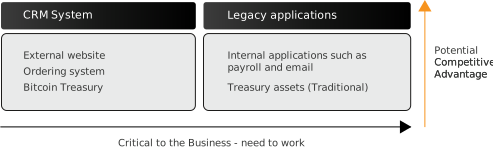
As with any new solution under consideration for adoption, a decision needs to be made on how this can best be achieved. One approach is to map the criticality of the technology or service to the business against the potential to use it as a competitive differentiation. This can help determine the appropriate resources to invest in it
Solutions that are critical to the business obviously need to always work, and internal resources will need to be assigned to ensure continuity of service. Paying your workers is critical, but not something you could market as a competitive advantage. You may decide to outsource this function but put strict KPIs in place on availability and performance, or run an in-house payroll system on internal IT infrastructure designed for high uptime.
Likewise traditional treasury assets need to be managed, accounted for in financial reports and hopefully support the ongoing viability of the business by maintaining or even increasing in value through shrewd investment.
Bitcoin creates an opportunity to also use the treasury to create a competitive advantage. We are still at the early stage of adoption, but companies that have adopted this approach have already seen their valuation increase and it puts the company in a more secure financial position as the value of the Bitcoin holdings increase. As the Custodial solution described above explains there are technical and logistical challenges that are created by the adoption of Bitcoin in the treasury. Using a Custodial solution may therefore make sense, but due diligence during the selection process will be critical.
5.2.8 Challenges and Considerations
When considering the approach to take when considering bitcoin for the treasury, one challenge is likely to be convincing some of the stakeholders of the merits of taking this approach. They may have heard some of the arguments against Bitcoin and raise concerns that will need to be addressed, These tend to fall into three main buckets:
Speculative: Bitcoin has no intrinsic value and is highly speculative.
Dangerous or a scam: It’s mainly used as a tool for money laundering and illicit activities.
Wasteful: It uses too much energy and is old technology.
To be successful, an understanding of these concerns and how to alleviate them may be required and this will need a good understanding of Bitcoin, both from a network perspective and as a store of value.
Maturing as a treasury asset: One of the concerns often raised is the volatility of the Bitcoin price. As it continues to mature, with larger buyers such as Governments and the ETFs now involved, there is potential for this volatility to reduce and for Bitcoin to stabilise as a treasury asset.
Layer 2 solutions: Lightning and other L2 solutions enable Bitcoin to achieve another key aspect of money, as a medium of exchange which is available at a very cost-effective price globally. This could offer any business the opportunity to offer services and payments to a larger potential customer base. Accepting Bitcoin as payment also offers an opportunity to increase the bitcoin treasury reserve directly.
Alternative assets: There is an existing ecosystem of crypto currencies, some of which are positioned as similar assets to Bitcoin. Many governments are also working on the development of CBDCs (Central Bank Digital currencies). An understanding of these and why they are not suitable treasury reserve assets would benefit any company considering adoption to ensure that a Bitcoin-only approach is taken.
5.2.9 SWOT Analysis
Looking at the implications to any business of adopting Bitcoin as a treasury asset:
Strengths:
Over the next several years, it is expected that holding Bitcoin will become more strategic and indeed vital for companies to succeed, by strengthening balance sheets and demonstrating leadership.
Weaknesses:
The public concerns around Bitcoin being wasteful of energy or being speculative may have an adverse effect on the company image.
Opportunities:
Other businesses late to the strategy will be looking to catch up and may choose to do so via acquisition of companies holding Bitcoin in the Treasury reserve. This could make the business a more attractive acquisition target, or protect the business from takeover as the cost may become prohibitive to companies without Bitcoin on the balance sheets.
Once Bitcoin has been held for a while, any internal investments should be expected to beat the Bitcoin hurdle rate – i.e. the return on investment by simply holding Bitcoin as a reserve asset. This should ensure that the business only focuses on high quality initiatives.
Holding an allocation of bitcoin is sound risk management. As it is on a path to establish itself as a global treasury reserve asset and a settlement layer for international commerce, the risks associated with not holding it are significant.
Evidence to date from publicly traded corporations that have adopted a bitcoin treasury strategy is that their share price has appeared to get an uplift in value from the market.
Threats:
The volatility of Bitcoin may continue or increase, or the financial returns may cease to be beneficial, which could have financial implications for the business.
Bitcoin could suffer a major technical failure which would affect the valuation.
The treasury could be compromised from a security breach.
5.2.10 Conclusion
We are at the early stage of adoption of Bitcoin as a treasury reserve asset, but the benefits of this approach are shown already in the financial success of early adopters. There are companies available to help educate companies on the process of acquiring and safely storing Bitcoin, and this ecosystem is expected to increase over time as the approach becomes more popular.
Although we have focused on larger companies as examples due to the complexity of requirements, any business no matter its size or location that generates revenue can start its own treasury reserve by simply buying and holding Bitcoin to gain the same benefits.
Whilst there are risks to any changes to the business, starting a Bitcoin treasury no matter the size of your business can be achieved safely and securely with the right help and can put any business on a sounder financial footing.