Bitcoin is not only a new entrant to the institutional investment sector, it has unique characteristics that pose challenges for traditional finance around how to classify and evaluate it. Bitcoin is only 15 years old and, for most of that time, it was a small and relatively illiquid asset dominated by individual investors. Participation in the bitcoin market by institutional investors has, so far, been limited. For many years, the absence of clear legal and regulatory guidance was an obvious hurdle and perhaps a convenient excuse for staying away.
The launch of futures markets in bitcoin around the end of 2017 was the first step in legitimising the asset for regulated investors. However, it was the regulatory approval of Bitcoin ETFs, in January 2024, that finally demonstrated to the professional investment management sector that bitcoin is now an established asset class that demands attention.
Now bitcoin is becoming a more widely-appreciated asset class, the key challenge for institutional investors is how to evaluate and develop an investment strategy around it. Wealth managers are under increasing pressure from clients to offer, not only an opinion, but a credible framework with products that allow clients to participate in this new asset class. Otherwise, they risk losing significant business to rivals with a broader-minded approach to building wealth.
Until recently, it was challenging for investment managers to justify spending any time to study bitcoin, let alone allocating capital to it. However, with client interest ramping up, we may have reached a point where managers without a bitcoin investment strategy must provide a valid justification.
This module considers some of the ways traditional investment managers might consider bitcoin the asset, its prospects, valuation metrics and impact on portfolios. It is not intended to be prescriptive - the investment management community is very broad in scope and style and each manager will have its own investment framework and process.
4.2.1 Coming around to bitcoin
Institutional investors can be considered in two groups. The first group consists of wealthy investors that may be participating via an investment vehicle or a family office. The group also contains specialist investors or hedge funds that are, by their nature, able to deploy capital relatively quickly. They may have few stakeholders, making them less constrained and more nimble with regard to investment decisions and strategy. They may be less constrained by regulation and have a higher risk tolerance. This group is already more likely to have some exposure to bitcoin.
The second group can be thought of as the more traditional investment sector. It consists of regulated investment advisors, larger asset managers, banks, mutual fund operators, pensions, endowments and sovereign wealth funds. It tends to move much more cautiously and has a lower risk tolerance.
This group is also much more conservative. Its members will have long-established and detailed investment frameworks and processes. Managers may be constrained by detailed mandates that restrict the assets or markets available. Allocation decisions are often made by committees made up of portfolio managers, analysts and compliance staff where ideas are deeply-researched and documented according to strict criteria, all under the watchful eye of a financial regulator.
It is easy to have sympathy for this group and the challenges it faces with bitcoin. By nature this group is conservative, resistant to change and, generally, this approach has served it well. In that environment, when a highly-innovative or disruptive technology comes along, the natural reaction is to be cautious, skeptical or to completely dismiss it, especially if much of the wider industry is doing the same. Therefore, in this highly-disciplined environment, it should be no surprise that this second group has moved much slower when allocating to a new asset like bitcoin.
Readers of much of the traditional financial media’s coverage of the Bitcoin network and protocol have noted that many commentators struggle to see where it fits within the legacy financial system. This is understandable. Bitcoin emerged from outside the existing financial system. And, as a technology that reimagines the concept of money itself, its adoption has the potential to render much of traditional finance obsolete. Of course, this resembles the disruptive technology playbook within other industries.
Nevertheless, increased demand for exposure from clients is forcing managers to consider bitcoin exposure in portfolios or risk losing clients. This demand was a key driver in the launch of Bitcoin ETFs by large asset managers BlackRock, Fidelity and others. This gave investment managers a regulator-approved vehicle, allowing them to satisfy investor demand for bitcoin exposure in a way that is compatible with existing investment mandates.
After 15 years of negative coverage from mainstream and business media, Bitcoin is still defying many naysayer predictions. The network continues to grow and metrics such as the number of public addresses, the network hash rate and the dollar value transacted, all point to technology that continues to grow exponentially.
Therefore, it is becoming harder for investment managers to justify not having an allocation to bitcoin.
4.2.2 Bitcoin: An Acceptable Alternative Asset?
Depending on their mandate (e.g. single asset, single strategy or risk-weighted multi-asset funds etc), large traditional investment managers will have their own well-established criteria and framework for evaluating potential investments. These processes are disciplined and rigorous, as they should be. Therefore, it may be challenging for an investment manager to see whether holding bitcoin in a portfolio can fit an existing investment process because it cannot be valued using traditional metrics used for other asset classes. Therefore, part of the evaluation of bitcoin as an investment should run alongside a review of existing investment processes.
From an academic perspective, the goal of effective investment management is to develop optimal portfolios at the ‘efficient frontier’. That is, the portfolios that offer the highest expected return for a defined level of risk, or the lowest measure of risk for a defined expected return. The key question for investment managers is whether an allocation to bitcoin can help achieve this goal.
Studies show that successful evaluation of risk versus return should place a portfolio at or near the efficient frontier. A common metric used to measure this is the Sharpe Ratio. It divides a portfolio’s excess return by a measure of a portfolio’s volatility, such as the standard deviation of excess return. A higher Sharpe is better when comparing portfolios.
It’s worth noting that portfolios at the efficient frontier usually exhibit a higher degree of diversification. That is, they contain a broad range of assets whose returns are not closely correlated in terms of price performance. Alternative assets tend not to be closely correlated with the major asset classes (stocks and bonds) and therefore can be an attractive prospect for investment managers seeking additional diversification in a portfolio. ‘Alternatives’, such as private equity, real estate, farmland, or even art and collectibles are increasingly on the watch-list of institutional portfolio managers as a diversification tool, especially given the significant underperformance of the bond market in recent years. Managers of the typical ‘60/40’ portfolio (60% stocks, 40% bonds) are under pressure to improve overall investment performance.
However, alternatives often come with a significant impediment. They may reside in markets that lack the depth of liquidity seen in larger stock or bond markets. It is challenging to find buyers or sellers in sufficient size. Even pricing an asset for portfolio purposes can be challenging as simply ‘marking to market’ can be unreliable in an illiquid market.
Bitcoin is an alternative asset that doesn’t have this drawback. It is a market valued in excess of $1 trillion and trades 24x7 globally. Volume traded is counted in tens of billions of dollars daily. Also, unlike other alternative investments, bitcoin is homogeneous, independently verifiable, easily divisible and has no counterparty risk, if held directly.
4.2.3 Analysing and Valuing Bitcoin
Professional Investment managers will already have an established rigorous process for evaluating potential investments. In 2017, business systems analyst Brian Leemoon developed a framework for appraising Bitcoin technology using three well-established business analysis methods: SWOT, PESTLE and Porter's Five Forces. From an investment manager’s perspective, a summary example SWOT analysis for Bitcoin might look something like this:
Strengths
Most recognised digital asset, open payment network/protocol with longest history
Highly stable protocol with no major changes to monetary policy
Highly stable network with 99.99% uptime since inception
Most secure and decentralized digital asset network
Most valuable and liquid digital asset market with the largest user base
Fastest growing digital asset network - no. of addresses, hash rate, value transacted
Enabling economic participation in developing world
Positive symbiotic relationship with renewable energy and other ESG benefits
Establishing as a treasury asset for corporations, strengthening balance sheets
Regulatory landscape is improving. i.e. approval of ETFs in the US
Weaknesses
Highly-volatile asset price with significant price drawdowns
On-chain transaction costs are highly variable
Lack of market education around functionality and properties
Challenging to value by investors
Lack of clear regulatory guidelines in major markets
Negative market perceptions and sensitivity to illicit or criminal use
Career/reputation risk associated with supporting Bitcoin within traditional finance sector
Could become illiquid if investor sentiments turns against the asset
3rd-party custodians are vulnerable to cyberattack or theft
Opportunities
Becomes established as a store of value and global treasury reserve asset
Becomes more accepted as a medium of exchange for goods and services
Success of application layer protocols will drive significant user adoption
User growth at a similar rate to the internet in the mid-1990s
Opportunity for improved investment returns through diversification (non-correlation)
Market dynamics ripe for demand - fiat monetary debasement likely to continue
Early-mover advantage potential for investment managers over competitors
Threats
Significant price rally leading to risks of a large price drawdown
Regulatory landscape in major markets turns against the technology
The network experiences a technical outage, impacting valuation perceptions
An ‘upgrade’ to the network results in unexpected technical problems
It is surpassed by another digital asset that has more user or regulatory support
This is not an exhaustive list and we should expect investors to hold varying views on the strengths and weaknesses etc. However, the exercise encourages analysts to gain a deeper understanding of the Bitcoin network, protocol and asset and consider what makes it investible. It is also important to revisit the analysis regularly since key elements of the ecosystem continue to develop.
The SWOT analysis also encourages analysts to make a comparison with the fiat monetary system. A general lack of acceptance of the problems associated with fiat money can be a roadblock to understanding Bitcoin. For decades, there has been very little discussion of fiat money’s drawbacks within investment or academic communities, largely because it is generally accepted that there is no credible alternative since the gold standard ended, giving way to a system of free-floating fiat currencies. That is, until Bitcoin came along.
Bitcoin has new and unique properties. Because of this there has been much debate around how to value it as an investment. A common critique is that it has no cash flows like stocks, bonds or real estate and it is, therefore, ‘uninvestable’. However, this may speak to the inflexibility of an investment process that requires rework to adapt to new ideas. It helps some investors to think of bitcoin (the asset) as a ‘digital gold’ with superior properties to physical gold. Gold also has no cash flows and has a long history of being used as money. Drawing a comparison of the monetary properties of gold, fiat and bitcoin can be instructive, similar to that contained in the 2018 article ‘The Bullish Case for Bitcoin’ by Vijay Boyapati.
In the absence of traditional measures of valuation, how should we consider the potential future value of bitcoin?
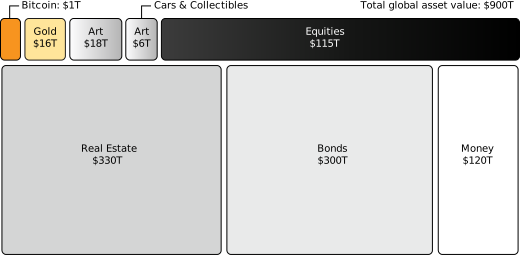
Analyst Jesse Myers4 at OnRamp suggests that because bitcoin can be thought of as new base money that can reprice all other asset classes, then the Total Addressable Market (TAM) for bitcoin is the entire world’s wealth (around $900T), that is, all value held in equities, bonds, real estate, money markets etc.
Global Wealth is Stored in Physical and Financial Assets (Sources: onceinaspecies.com; hope.com)
Of course, the capture of a majority or even a large portion of the world’s wealth is not expected to happen anytime soon. This is a multi-decade story. So, in the meantime, how can we track that the Bitcoin network is trending in the right direction, so that this investment thesis for bitcoin (lower case b for the asset) remains intact?
For the Bitcoin network there are many metrics5 we can track to monitor activity on the network. Below are some examples. This is not an exhaustive list and a full description of each is beyond the scope of this module.
Hashrate of the network (the total combined computational power being used to mine and process transactions on the Proof-of-Work Bitcoin ledger)
Dollar value transacted on the network
Number of bitcoin on exchanges (a measure of scarcity of the available bitcoin for trading)
Number of users, active wallets on the network (base layer & layer 2 such as Lightning). It is worth noting that estimates of these can vary significantly, so it is important to choose a consistent methodology in order to monitor trends reliably.
Number of active nodes on the network
HODL waves (the distribution of bitcoin holders based on how long they have held coins)
The trend of Bitcoin-related media publications, such as films, books or mainstream media articles.
The trend in the number of merchants accepting bitcoin payments in major economies. This can be tracked on btcmap.org
Tracking a basket of metrics for the network helps a manager monitor if the investment thesis remains intact. In addition, tracking the progress of publicly traded related stocks (such as miners or companies offering bitcoin exposure) can provide additional supporting data. These stocks can also be valued using traditional metrics that professional managers will already be comfortable with, such as discounted cash flow models or ratios such as price/earnings, price/sales, price/earnings growth, price/free cash flow, or price/book value.
4.2.4 Bitcoin’s impact on Portfolios
Despite being only 15 years old, by August 2025 bitcoin had established itself as the world’s 7th most valuable asset. While it’s important for investment managers to understand the nature of Bitcoin and its potential impact on the economy and society, the key question from a professional perspective is the potential impact on portfolios.
If we believe that Bitcoin can capture a significant portion of global wealth over the long-term, then it seems reasonable to have an allocation to it as a high-powered return enhancer. However, it is important to consider whether the return is worth the risk. This is captured by the Sharpe Ratio mentioned earlier. A manager should also consider diversification. That is, how correlated an asset’s investment returns are when compared with other assets in the portfolio, while also considering the risks around price volatility and drawdowns.
There is publicly available information on the impact of bitcoin on portfolios at Fidelity Investments or the Nakamoto Portfolio from Swan Research. In a study updated in June 20248, Fidelity conducted returns, volatility and correlation analysis of bitcoin relative to stocks, bonds and gold within a 60/40 stocks/bonds portfolio. It found that bitcoin did offer some diversification benefit, although correlations vary.
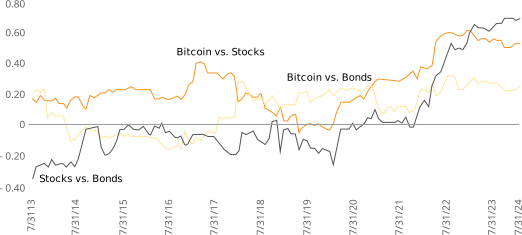
The chart below shows rolling 3-year correlations of bitcoin relative to stocks and bonds, from July 2013 to March 2024. It shows that, while correlations between stocks and bonds are increasing. A rolling 3-year correlation to stocks of 0.53 and to bonds of 0.26 through to March 2024 shows significant potential for diversification in a multi-asset portfolio.
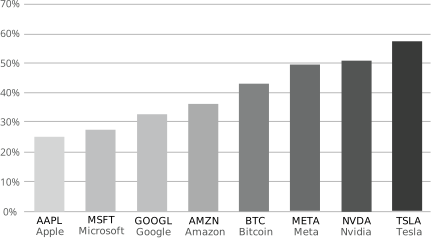
Magnificent Seven: 1-Year Volatility (Source: Fidelity Investments and Bloomberg Finance)
The total market capitalization of bitcoin didn’t exceed $100B until mid-2016. Therefore measuring early correlations may be less meaningful since the bitcoin market lacked depth, liquidity and pricing efficiency in early years, especially prior to January 2018 when the first bitcoin futures contracts began trading.
From a returns perspective, Fidelity observed that since August 1, 2010 to March 31, 2024, bitcoin achieved annual returns of 178%, while noting that since the establishment of futures trading, annualized returns are around 29.6%. Of course, the past is no guarantee of the future. However, it is clear that bitcoin has potential to significantly enhance portfolio returns.
Bitcoin’s price volatility is often cited as a reason that investment managers steer clear of bitcoin as a portfolio constituent. It is a slightly odd criticism, since managing price volatility of individual assets within a portfolio is a well-understood attribute of a competent portfolio manager. Furthermore, Fidelity found that bitcoin’s annual price volatility is not dramatically different to the ‘magnificent seven’ group of high-performing technology stocks.10 At the end of 2023, there were 92 S&P stocks more volatile than bitcoin.
Rolling 3-Year Correlations of Bitcoin, Stocks, and Bonds (Source: Fidelity Digital Assets; Bloomberg)
Fidelity also observed that bitcoin’s volatility is declining over time. This is to be expected as the market matures. A deeper and more liquid market allows for greater capital inflows with less impact on the market price.
High price volatility, measured by the standard deviation of returns, is also well-understood by investors as a by-product of high performing assets. As shown in the table below, for the period from 2020 to early 2024, bitcoin investors have been well-compensated for its volatility, showing a Sharpe ratio of 0.96 versus 0.65 for the S&P 500. The Sortino ratio is perhaps more instructive, since it only considers downside standard deviation of returns or “bad” volatility. Its value of 1.86 shows that the majority of volatility over the four years was to the upside. This is despite some significant price drawdowns over the period.
Feb 2020 - Feb 2024
CAGR
Std. Deviation
Sharpe Ratio
Sortino Ratio
S&P500
13.6%
19.56%
0.65
1.01
Bitcoin
58.0%
72.9%
0.96
1.86
The bottom line is that bitcoin is a volatile asset. This is to be expected because it is new and on a long voyage of price discovery and user adoption. Professional investors are well-equipped to embrace this volatility and, given the potential for supernormal returns, manage it accordingly. They can determine the appropriate allocation, in line with their own investment framework and appetite for risk. And, to smooth out short-term volatility, holding bitcoin for at least one, 4-year, halving cycle could be an appropriate minimum holding period.
Is Bitcoin an Inflation Hedge ?
Because bitcoin is a fixed supply asset, supporters have long-argued that it serves as a hedge against inflation in fiat currencies. It is clear that over the very long-term bitcoin has served as a very effective hedge against the debasement of purchasing power in fiat money. However, critics point to the dramatic rise in the year-on-year CPI metric11 from early 2021 to a 40-year high in mid-2022 and question why the bitcoin’s price didn’t see significant upside over this period. So did bitcoin fail as an inflation hedge?
It is important to note that we have only observed such a significant rise in inflation once in the whole of bitcoin’s history, so we should be careful to draw conclusions. However, it is well understood that CPI is a backward-looking metric. That is, it reacts to price rises for goods and services that have already happened. In turn, those price rises are often a downstream result of increased money supply in the wider economy.
Money supply within the global economy rose dramatically during 2020 as a reaction to the COVID-crisis. Multiple large nations took the decision around the end of Q1 2020 to shut-down significant portions of their economies and, to plug the hole in tax revenue and to support many millions of people not working, they created trillions in new fiat money.
Bitcoin’s price also rose dramatically from mid-2020 to the end of Q1 2021, rising more than six-fold. Therefore, it appeared to foreshadow both the downstream increases in consumer prices and the CPI metric. Therefore, it functioned well as an alarm bell signalling a dramatic rise in global liquidity, leading to a future increase in CPI inflation.
4.2.5 The Shifting Narrative
Since the start of 2024, there has been a significant shift in the narrative around bitcoin within traditional finance. The market entered 2023 with the overhang of the FTX collapse still present. As a result, large swathes of the industry were not considering bitcoin as a seriously investable asset.
Moving forward one year the narrative has shifted considerably. The US SEC approval of Bitcoin ETF products represents a transformative shift in the regulatory landscape. This development effectively opens the door to professional investors, allowing them to enter this asset class via a regulated product, issued by highly-regarded and long-established asset managers.
After just nine months of trading, Bitcoin ETFs were ranked the most successful ETFs ever launched. After just two full quarters of trading, they had already broken records for the most money attracted in the first year and the highest number of institutional holders.12 In the wake of the ETF approvals and their trading success, leading investment firms (such as Blackrock, Fidelity and Cantor Fitzgerald) are making considerably more positive market comments on the prospects for bitcoin. This piles on the pressure for investment managers that have yet to develop a coherent bitcoin strategy.
It is becoming increasingly difficult for professional investors to justify not having some exposure to bitcoin, if only in an intellectual sense. Moveover, the shifting narrative has helped to pull back the curtain on the fiat monetary system, further exposing its inherent flaw - it declines in purchasing power over time.
Ultimately, the role of Investment professionals is to manage risk. With that in mind, it is worth considering what ‘zero exposure’ to bitcoin is suggesting from a risk management perspective.
Is it akin to a bet, with 100% certainty, that the Bitcoin network and protocol will fail? If so, is that sound risk management?
In the world of traditional finance, bitcoin sceptics remain in the majority. This should be no surprise. The sector is by nature conservative, operating as it does in a highly-regulated environment. Within this setting and moving in circles of where conformity is encouraged, there is little advantage to be gained in being an early-adopter of new and disruptive technology. Indeed, there may only be increased career-risk for trying to get ahead of the herd.
However, like other disciplines such as insurance or engineering where sound risk management is essential, the need to be effective should supersede the desire to be correct. Therefore, bitcoin-skeptical investment managers should seriously consider some exposure, due to the risk of significant overall underperformance if bitcoin continues to perform well over the long-term. The performance risk associated with zero exposure should not be ignored.
4.2.6 Bitcoin’s Future Impact on Investment Management
It is also worth considering what long-term impact the rise of bitcoin in portfolios may have on the investment management industry.
Fiat money’s ‘store of value’ problem has been a key driver behind the growth of the professional investment management sector since the 1970s. The inability of fiat money to store purchasing power while residing in a simple savings account, has led to an explosion in investment products, directed at consumers seeking to grow or to simply maintain their purchasing power.
A side effect of this phenomenon is that the major asset classes - stocks, bonds and real estate, have all attracted significant valuation premiums thanks to their superior ability to store value over the long-term. Furthermore, as fiat money’s debasement has accelerated, capital flows toward these assets has ramped up further, leading to malinvestment and distorted valuations, which potentially lead to asset bubbles and poorer outcomes for investors. It is argued that this effect can also be observed in the valuations of alternative assets such as art, vintage cars and other collectibles.
In a future world where bitcoin is more recognised as a superior store of value versus other asset classes and establishes itself as a treasury reserve asset, what impact would this have on valuations in other asset classes?
The long-term impact could be dramatic: bitcoin could draw the ‘monetary premium’ from other asset classes, slowly at first, and then more quickly as its properties become more widely understood. In this scenario, a large swath of investment products become obsolete, with the result that the investment management sector declines in size. In time, the sector’s slice of the wider economy may shrink to resemble the proportion it held 50+ years ago.
Of course, not many commentators expect this scenario to play out soon - bitcoin’s global adoption is a multi-decade story. However, those investment management firms that are prepared already have a huge advantage over those that are not. Therefore, it is essential for all investment management firms to have ‘The Rise of Bitcoin’ on their Risk Registers. And, even the most skeptical managers should ask:
What if, like the rise of the internet, we can’t simply choose to opt-out?
Warning
Note that past performance is no guarantee of future results. Bitcoin is an asset that comes with high risks. Investors should keep in mind that its value has both the potential to significantly increase or decline in the future, as past performance has shown.
Bitcoin doesn't yet have the long-term histories of the stock and bond markets, which means it's tough to confidently estimate its returns. Note that bitcoin is still an emerging asset, and its impact on portfolios may evolve over time.
Note bitcoin is highly volatile, and may be more susceptible to market manipulation than securities. The future regulatory environment for bitcoin is currently uncertain.
Correlation reveals the strength of return relationships between investments. A perfect linear relationship is represented by a correlation of 1, while a perfect negative relationship has a correlation of -1. A correlation of 0 indicates no relationship between the investments. Correlation is a critical component to asset allocation and can be a useful way to measure the diversity of a portfolio.
It is more socially injurious for the millionaire to spend his surplus wealth in charity than in luxury. For by spending it on luxury, he chiefly injures himself and his immediate circle, but by spending it in charity he inflicts a graver injury upon society. John A. Hobson
4.7.0 Introduction
Governments will not only lose their power to tax many forms of income and capital; they are also destined to lose their power of compulsion over money. James Dale Davidson
As discussed in the chapter aimed at governments, the rise of Bitcoin is likely to place significant pressure on state funding of welfare services. This added pressure is likely to develop at the same time as many western economies face aging populations.
The displacement of the state as a funder and/or deliverer combined with greater needs from their populations will lead to much greater needs for charitable activities and the philanthropy to support them. In a world where financial assets can be held self-custodially and in a dematerialised form, high levels of coercive taxation are only sustainable, even in democracies with electoral consent, by the imposition of currently unacceptable levels of restriction on freedom of movement. See the quote above from The Sovereign Individual, or read it in full.
However, there are also opportunities for charitable and not for profit organisations. It is not that their services will no longer be in demand, quite the reverse. And many of those who through learning and foresight become wealthy through this transition will follow the path of those who came before (for example Rockefeller and Carnegie) and become philanthropists as they see the need and acquire the means.
4.7.1 Risks
I’m obliged to pay so much to the poor by law, that I am not of ability to bestow in voluntary contributions….this checks and weakens the charitable principle within; and this principle, by not being exercised … grows weaker and weaker, and, in time, perhaps, is quite extinguished Thomas Alcock
The risks that charities face emanate from the following observations:
An increase in societal demand for health and welfare services due to demographic change (in the developed world)
A decrease in the capability of the state to continue providing existing services
A decrease in the power of the state to provide financial support to charities to support existing services
The above lead to risks that charities and not for profit organisations may face increased demand for services at the same time as a key source of funding is falling.
During the 20th century the state came to be the dominant provider of health and welfare services in most developed countries, areas which had previously been largely the domain of charities, community groups and religious establishments. The emergence of the welfare state since the second world war has been predicated on the rise in power of nation state governments. If this were to reverse then gaps in social provision will open up and people will seek to organise to cover these gaps.
It is repugnant to a civilised community for hospitals to have to rely upon private charity. Aneurin Bevan
Whilst many people, including politicians, have made ethical claims about reliance on charities as “repugnant” or similar, it may turn out that holding such views was a temporary privilege. In any case, such ideas have been intellectually contested. A return to the expectation that those with the broadest shoulders will bear the greatest burden through philanthropic engagement rather than coercion may turn out to be both ethically and socially beneficial.
The current and future advancement in global technology and productivity means that such a change will not be a turn backwards to the world as it was before the 20th century. The resources to provide the generally desired safety nets today far exceed those available previously. Indeed Bitcoin, by driving better resource allocation decisions, capital growth and a lower time preference, will itself provide a new basis for increasing the resources that the global economy can produce.
4.7.2 Threats
Change is the law of life. And those who look only to the past or present are certain to miss the future John F. Kennedy
Funding
Charities or not for profit organisations that receive funding from central or local government may face reductions in these flows due to the decentralisation of financial power away from these political entities.
The same risk applies to those organisations who derive significant funding from corporations that may themselves face challenges from the rise of Bitcoin, In particular, we would highlight those corporations that today operate in the financial services environment. If these funding organisations are not themselves actively planning and responding to this emergent technology then their ability to continue to support charitable activities may fall.
Charities that source some of their funding from investments, legacies or endowments may find that real returns from these fall as Bitcoin reduces some of the monetary premium they currently hold. In particular this may affect real estate, gold and stocks. Bonds may also lose real value not just as a consequence of over-indebted states, but also as they face competition from the rise of a new monetary asset.
The demographics of funding have always changed over time and this is not new. However, what may happen due to the rise of Bitcoin is that the difference in values and perspectives of the replacement generations may be radically different from what has been seen in the past.
Demand growth
As governments become less able to provide some health and welfare services there will be an increasing amount of unsatisfied demand in society. People will increasingly look to smaller, local community organisations to help meet this demand. New organisations will emerge, supported by newly engaged donors.
The developed world faces a demographic time bomb caused by aging populations and reducing fertility rates. These trends are driving governments further into debt and in many cases increasing the burden of unfunded future liabilities. Many current demands are not being met, and promises that almost certainly will not be met are being made. This is driven by short term political expediency, but it has the unfortunate repercussions of raising expectations way beyond what can actually be delivered. Such expectations are a source of future demand since when they are not met, people are likely to have made inadequate private provision, even where they may have been able to had they not received the promises in the first place.
4.7.3 Opportunities
In this section we highlight some possible opportunities for charities and not for profit organisations that Bitcoin may offer. They are not comprehensive, but they are opportunities for most organisations and they are intended to stimulate thought.
One key insight is that should Bitcoin continue on its path of becoming an increasingly valuable worldwide asset and currency then there is a demographic cohort already involved today from whose ranks will emerge many of the philanthropists of tomorrow. They are a motivated and committed group many of whom already understand that with great wealth comes great responsibility. They are likely to be increasingly willing to engage with and support charities that position themselves ethically to help those in need, whether that need is current, or emergent as governments become increasingly unable to meet promises made in the past.
With the new demand and the new funding cohort, it may be worth considering starting a subsidiary charity or not for profit organisation. A new arms length subsidiary may achieve better focus and be able to innovate faster in both delivery and fundraising. You may even be able to find Bitcoiner staff who are willing to volunteer their time to help you, as well as providing the means to support philanthropy financially, because having wealth also makes people the owners of their time.
Accept and target bitcoin donations
Accepting bitcoin is an easy, low cost way to engage with the Bitcoin demographic. There are many businesses across the world now doing this to generate additional revenue, using various social media and online services to promote themselves, often for free. By accepting bitcoin, organisations are opening themselves up to a growing global market of people who are getting wealthier over time. This market is relatively easy to target at present as it is fairly cohesive across social media and online platforms.
In some tax jurisdictions, capital gains tax is due when spending bitcoin in businesses. However, donations to charities may not be taxable thus reducing friction more than for businesses.
Building a reputation within this global community at present will be a lot easier than in a few years time when it is much bigger and your charity is one of hundreds accepting bitcoin. Further, the people you engage with today are likely to make up a larger share of those becoming philanthropists in the future than those who adopt Bitcoin later. Engaging with this demographic opens up a global opportunity to be considered for Bitcoin legacies as well as other non-financial support such as volunteering.
Treasury Management
For charities and non profit organisations that service some income from investments or/ endowments, the inclusion of an allocation to bitcoin within the investment mix can deliver superior returns for a given risk by increasing the Sharpe ratio. See Chapter 7.3 ‘Treasury Management’ for more information on this.
Delivery Innovation
Many businesses engaging with Bitcoin introduce products and services specifically aimed at this market to further drive revenue and loyalty. There is an opportunity for charities to look at how Bitcoin technology may provide a platform for improving their service delivery.
We provide just one example here to help illuminate the idea and help your innovation process.
‘Bank’ the unbanked: Bitcoin payment cards, provided and recharged by a charity, could help people without bank accounts, either due to identity issues or unprofitability, to access services such as food banks whilst retaining privacy and dignity. Such a solution may also promote skills related to independent living like making budget-based decisions in store. This can provide a basis for recipients to experience financial management even though they currently have no access to banking. It could also help tp ensure payments get to localised areas of need quickly and cost-efficiently.
Delivery Structure
Consider decentralising structures to engage local communities more. A more decentralised structure is likely to promote ground up engagement and may better reflect the move to a more decentralised world.
Demand Growth
Identify the crossover between your organisation’s charitable objectives and the areas where there are currently unmet needs, or where the government currently meets some needs but may withdraw or reduce provision should they face financial challenges in the future.
Prioritise and make plans for expanding your services into these areas.
4.7.4 Activity
Design a fundraising campaign aimed at the Bitcoin demographic.
Some things you might consider:
Why will the philanthropists who emerge from this technology change want to engage with you?
What values does the demographic hold?
How does your charity / campaign intersect with these values?
What commitment to Bitcoin is most likely to attract donations?
What is the geographic distribution of this demographic?
What are the wealth cohorts within the demographic today, and in future?
How can you communicate with and reach them?
How can you develop a long term relationship and trust with the cohorts?