To understand Bitcoin, you need to understand the problem it solves Wences Cesares
A global ecosystem of economic activity is building around the Bitcoin network and its acceptance as both a store of value and a medium of exchange. This system is made up of markets for custody, payment services, hardware and services within the mining and energy industries, as well as wider financial services such as trading and derivatives. Participants in these markets range from individuals to large institutions, all of which are interacting with a common network infrastructure built on open-source software protocols.
At the heart of this system is a globally distributed, publicly-auditable ledger that transparently records every transaction. The decentralised and observable nature of the ledger and its underlying data allows for real-time economic analysis at a global scale by individuals and institutions alike without reliance on intermediaries. Therefore, unlike the traditional monetary system, much of Bitcoin’s internal activity is fully observable.
8.1The Nature of Bitcoin's Ledger
Bitcoin’s transaction ledger (alternatively named the timechain or blockchain) is a publicly-accessible, time-stamped record of every valid transaction that has ever occurred on the network. Within the legacy financial system, internal transactions are only visible to authorised participants, such as banks, regulators, or data operators like SWIFT, BACS or SEPA. Access to payment data on traditional systems can be highly-restricted and expensive.
By contrast, within the Bitcoin network, anyone with an internet connection can view every transaction from the largest amount of value down to the individual Satoshi. Participants can track the total supply of bitcoin in real-time, monitor address and wallet activity, and view miner rewards and fee behaviour. While viewable activity on the ledger is linked to public key addresses and not individual identities, it is possible to aggregate large data sets on spending behaviour, allowing everyone to collate and research economic activity in real-time. As the network grows and becomes more accepted as a source of economic truth, we may see less reliance on government bodies and third-party providers for the production of statistical analysis and reports of spending behaviour.
8.1.1 Nodes and Block Explorers
Anyone wishing to independently verify the Bitcoin ledger and access its data should run a full node. The full node is often described as the most fundamental way to participate in and verify the Bitcoin economy. It is globally available as open-source software that, when executed, will download and validate the entire Bitcoin ledger from the ‘Genesis Block’, published in January 2009, right through to the present day. It also supports the security of the Bitcoin network by helping to verify new transactions being added to ledger. By accessing the Bitcoin ledger in this way, the full node serves as a source of truth for researchers and auditors of the network. And, for Bitcoin users, the full node acts as a ‘self-sovereign’ gateway to the transactional information of the Bitcoin economy because it enhances privacy and security by removing reliance on third-party services.
While full nodes download the raw data, block explorers such as mempool.space or blockstream.info offer a visual interface to search and interpret ledger activity. The block explorer allows individual transactions to be tracked and wallet balances and histories to be viewed. It also shows miner activity metrics such as block rewards and transaction fee data.
Together, full nodes and block explorers are the tools that make the transparency of the Bitcoin network usable.
What is the current transaction fee (Low, Medium and High Priority)?
How many transactions are waiting in the mempool for the next block
Access the latest block on the ledger.
How many transactions were included?
Name the miner of the block?
What was the block reward?
Access a transaction in the block.
How many inputs and outputs does the transaction have?
What is the transaction value in BTC and USD?
Discuss the differences from how money moves within the legacy system and how a business or government uses this kind of transparency.
8.2Metrics for Analysing the Ledger
Because Bitcoin’s transparency is unlike traditional financial systems — where much of the monetary flow happens behind closed institutional doors — it gives rise to a rich field of on-chain analytics, where network-level data becomes a lens for understanding user behaviour, monetary flows and long-term trends. These metrics can help answer specific queries, such as how actively the network is being used, whether coins are being accumulated or sold off, and whether the network is becoming more secure.
Understanding these metrics is helpful not only for Bitcoin users, but also for researchers or policymakers seeking insight into this uniquely transparent financial system.
This section contains some commonly used metrics for analysing Bitcoin activity grouped into sub categories. It is not a comprehensive list. Visit www.bitcoinmagazinepro.com/charts for a fuller list and descriptions.
8.2.1 Address Metrics
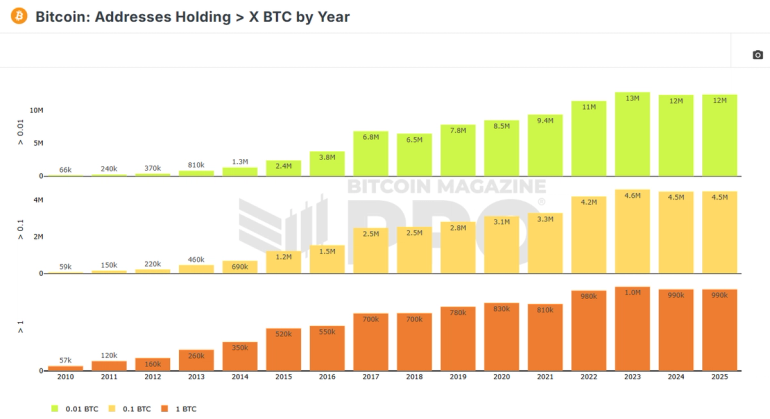
Address metrics are useful to monitor over time as they indicate the level of activity on the Bitcoin network. For instance, as Bitcoin becomes more adopted, the number of active addresses increases. We can examine this further by distilling the number of addresses that hold a minimum specified amount of Bitcoin, say 0.1 BTC, by a certain time period, such as one year. While this provides a view of Bitcoin adoption over time, it is imperfect since an individual can hold multiple Bitcoin addresses. Conversely, exchanges or ETFs may appear as single entities when holding funds for large numbers of individuals.
Addresses Hodling Bitcoin > X BTC by Year. Source: Bitcoin Magazine Pro.
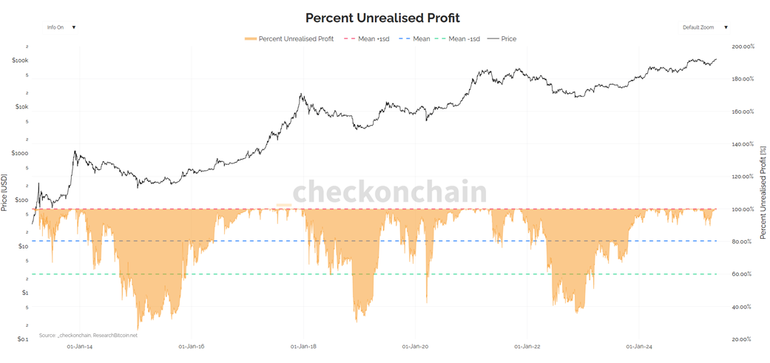
By comparing addresses with the current market price of BTC it is possible to view the percentage of overall Bitcoin addresses in profit. This allows us to track market sentiment as we can see what proportion of the market is holding on to BTC at a profit or loss.
For example, the Percent Unrealised Profit chart below shows the proportion of all ledger addresses with an unrealised profit measured in US dollars. Note that, since the chart below was taken at close to Bitcoin’s all-time high, the percentage of addresses showing an unrealised profit is close to one hundred per cent. We can also see that prolonged periods of Percent Unrealised Profit below one standard deviation from the mean are unusual. Therefore, a drop below this line may suggest a good entry point for buyers.
On-chain indicators are useful because they offer an insight into network behaviour, beyond what price and address metrics alone can show. They help analysts understand the actions and sentiment of different types of participants, such as long-term holders versus short-term traders by tracking how coins are being held, moved, or valued over time. These indicators draw on the transparent nature of the ledger to reveal hidden market dynamics like accumulation, distribution, or even investor conviction. This makes them particularly useful for identifying structural trends, assessing whether the market is overheated or undervalued, and anticipating turning points in a market cycle.
For instance, by examining the value of BTC holdings since they were last transacted, we can deduce whether or not the market is under distress (as it might be during a major cycle low). This metric is known as Realised Price and gives us an ‘average cost basis’ of all BTC in circulation. If the market price drops below Realised Price, this shows that on aggregate the majority of addresses are holding a paper loss.
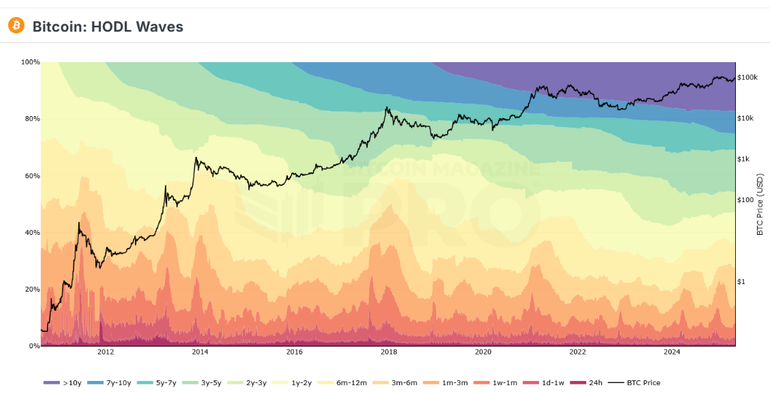
By further grouping ledger data into age bands, we can show how the amount of BTC moves between addresses over time, which creates wave-like patterns on a chart known as HODL waves.
Bitcoin HODL Waves. Source: Bitcoin Magazine Pro.
The HODL waves show what long-term, medium-term and short-term holders are doing with their BTC. For instance, in the chart above, short-term holders are shown in red and orange and we can see spikes in activity as this group rushes to buy near market tops. At the other end, we can see that very long-term holders (in purple and blue) are steadily increasing in overall share of the network, indicating high conviction among these groups. The chart is imperfect since some coins can move from old to new addresses under the control of the same user. However, it does provide an interesting view of the conviction of long-term holders.
Another way of examining the ‘smart money’ of long-term holders is to examine Coin Days Destroyed (CDD). The concept of ‘Coin Days’ is a multiple of the number of BTC multiplied by the days since the coins last moved. For instance, 5 BTC that has not moved for 100 days has accumulated 500 coin days and 10 BTC that has not moved for 10 days has accumulated 100 coin days. In this way, we give extra weighting to coins held for longer. When those coins are moved those coin days are ‘destroyed’. This indicator shows increases in CDD at times of significant price movements, which provides analysts with a way of separating routine market activity from meaningful shifts in longer-term holder sentiment.
Another metric that may help identify whether the market is undervaluing or overvaluing BTC is the Market-Value to Realised Value or MVRV. It is calculated simply as the ratio of Market Value (number of BTC in issue multiplied by the market price) divided by the Realised Value (the sum of all BTC since they were last moved). A high MVRV suggests more coins are in profit (often seen near market tops) and a low MVRV indicates many coins are held at a loss (seen near market lows).
8.2.3 Mining Metrics
Mining metrics are useful for understanding the security, economic incentives and overall health of the Bitcoin network. Metrics such as hashrate, miner revenue, difficulty, and fee ratios reveal how much computational power is securing the blockchain and how well miners are being compensated for their activities.
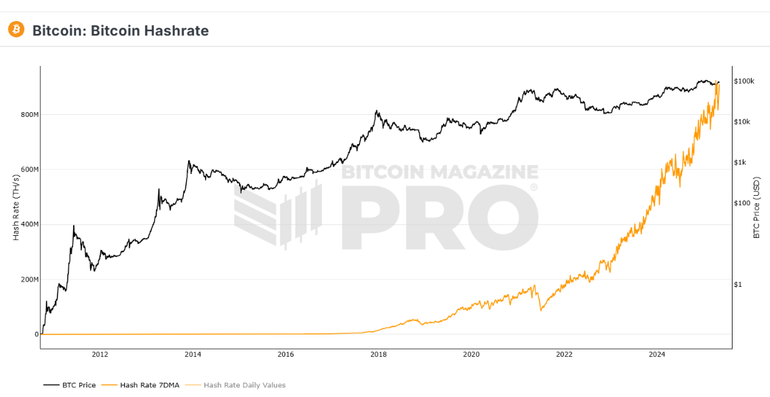
The Hashrate of the Bitcoin network is perhaps the commonly referred to indicator of the network health and strength of security. Since the process of mining secures the network and confirms that transactions on the ledger are valid, the greater the level of computing (or hashing) power there is, the harder it would be for a malicious actor to overpower and attack the network.
Bitcoin Hashrate. Source: Bitcoin Magazine Pro.
The chart above shows that, in May 2025, the total computing power of the network stands at around 900 TeraHash/s (900 Trillion cryptographic ‘hash’ calculations per second). If the hashrate is rising, it shows that the network is becoming more secure, which is reassuring for users.
The Puell Multiple (devised by David Puell) looks at the market cycle from the perspective of miners and their revenue. The metric is calculated by dividing the daily issuance of BTC (in USD) by the 365-day moving average of daily issuance value. The metric helps to identify periods of miner stress or relief. Historically, a multiple above 3 has preceded a decline in market value of BTC, since it indicates that miners are highly-profitable. A value below 0.5 indicates stress and has historically indicated market lows for the value of BTC.
8.3The Future of On-Chain Metrics
Many people believe that decentralization means loss of control. That's simply not true. You can improve control if you look at control as the control of events and not people. Then, the more people you have controlling events - the more people you have that care about controlling the events, the more people you have proactively working to create favorable events. Wilbur L. Creech
The future of on-chain metrics in the formulation of macroeconomic data holds significant promise, especially as the Bitcoin economy continues to grow in scale and relevance.
Unlike traditional economic indicators which often rely on delayed, survey-based, or opaque reporting, on-chain data provides real-time, transparent and immutable records of value transfers. As Bitcoin becomes more integrated into global commerce, on-chain transaction volumes, user activity, and network interactions could serve as real-time proxies for consumer spending, remittances and capital flows.
The open nature of the Bitcoin ledger effectively means that anyone can use its data to compile and report on macroeconomic trends or divergences without having to rely on reports from centralised or ‘official’ government sources. While the metrics described in this module already serve as leading indicators of investor sentiment and risk appetite, in the future they could serve as critical inputs to broader economic models of market and consumer behaviour. These could be generated in real-time and from a bottom-up perspective, challenging conventional methods of building economic models.
8.4The Pizza Day Transaction
So far, this module has focused on using the open nature of the Bitcoin ledger to compile useful metrics from aggregated transaction data. However, it is possible to use ledger data and block explorers to examine real-world transactions and trace the movement of funds within the network.
Every year on the 22nd of May, the Bitcoin community acknowledges Laszlo Hanyecz, who became the first person reported to use bitcoin to purchase physical goods. On the 18th May 2010, Hanyecz announced on a Bitcointalk.org forum that he was looking for pizza and was willing to pay in BTC. He offered 10,000 BTC to anyone willing to enter into the transaction. He waited for several days, until 19-year-old student Jeremy Sturdivant obliged and sent two large pizzas.
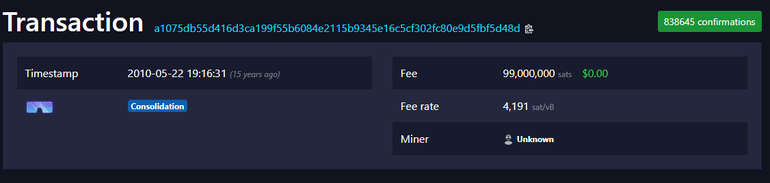
The Pizza Day transaction can be viewed by anyone and has the following transaction ID:
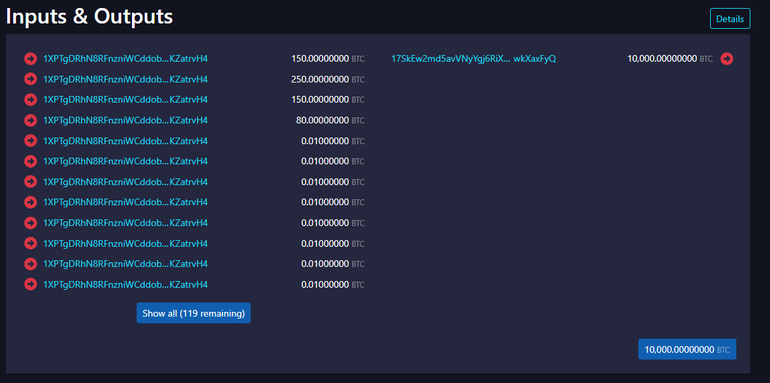
Entering this transaction ID into mempool.space reveals the following:
Date of time of the transaction: 22nd May 2010
Network transaction fee: 99,000,000 sats (at the time it equalled less than 1 US cent. In May 2025, this stands at $95,072.67)
The Block Height: 57,043
The Number of Confirmations: 838,645 (this is the number blocks added to the ledger after this transaction)
Number of Transaction Inputs: 131
Number of Transaction Outputs: 1
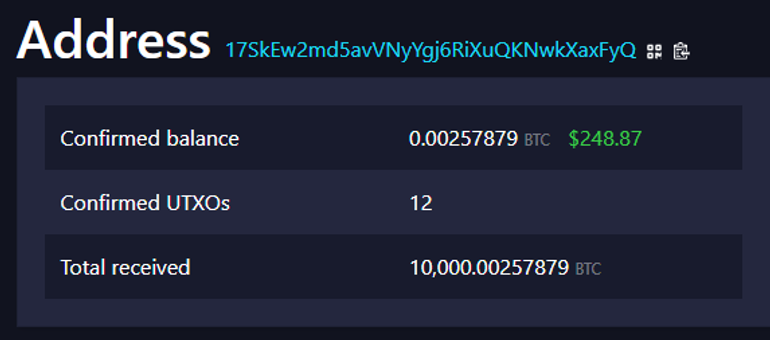
Clicking on the output public key (ending in XaxFyQ) that we know was owned by Jeremy Sturdivant who received 10,000 BTC for two pizzas, reveals the following:
This address currently has a balance of 0.00257879 BTC and it appears that it has been involved in 14 transactions, the most recent of which was on 13th December 2024.
8.4.1 Activity: Group Discussion
Describe the benefits (e.g. auditing, accountability) or risks (e.g. privacy concerns) for individuals or businesses using such a transparent and open transaction system.
How might this kind of financial transparency affect industries like charity, government procurement, remittances or law enforcement?
Should traditional banking systems offer a similar level of visibility? Will they be forced to by the market?