4.1Bitcoin and Energy

According to the Cambridge University Electricity Consumption Index (CBECI), Bitcoin’s power demand is around 148 TW annually (as at Oct 3, 2024), equal to around 0.6% of the world’s total electricity consumption.
4.1.0 Bitcoin’s Energy Debate

The Bitcoin network’s relationship with energy is perhaps its most controversial and misunderstood attribute. In a world where political discourse is increasingly sensitive to mankind’s impact on the environment due to increased industrialisation and trends in consumer behaviour, the emergence of a technology that harnesses a large amount of energy for its operations is bound to attract significant public scrutiny. However, much of that scrutiny is not particularly informative, and in many cases is wildly-inaccurate, as the tweet from the World Economic Forum above demonstrates.
Critics argue that the energy-intensive nature of Bitcoin mining — driven by the Proof-of-Work (PoW) consensus mechanism — contributes to carbon emissions, placing additional stress on global energy grids which, in turn, undermines climate goals. Reports highlighting Bitcoin’s energy usage, at times surpassing entire nations like Argentina, have fueled concerns that the network is exacerbating environmental degradation rather than supporting sustainability efforts.
However, there is a growing counter-narrative suggesting that Bitcoin mining may actually have a positive role in modernising energy grids and facilitating the transition to renewable energy sources.
So, can Bitcoin be a net positive for the environment? Can it contribute to grid efficiency and stability, and therefore help to drive the transition to renewable energy production?
4.1.1 Using Energy as Security
The Bitcoin network’s primary function is to maintain a decentralised ledger of transactions. In the absence of a central authority to validate it, the network requires a way to ensure the ledger's integrity and prevent a ‘double-spend’ from taking place. All network participants must agree on the state of the ledger (who owns what) at a particular point. This is where mining comes in.
Miners use specialised computer hardware or ASICs (Application Specific Integrated Circuits) deployed over a vast global network. The ASICs are designed to repetitively guess solutions to a cryptographic puzzle which involves performing quintillions of calculations per second. A successful guess results in a reward for the miner in the form of newly-minted bitcoin and the network cryptographically verifies in real-time that the miner has been successful. Hence the process is termed ‘proof-of-work’.
Collectively, the global network of miners contributes an immense amount of computing power. This happens by design as it secures the network - a bad actor attempting to attack or manipulate the network for their benefit must deploy enough computing power to control the majority of the network. If this were possible, it would require enormous financial resources and still be unlikely to maintain control for a period long enough to significantly disrupt the Bitcoin network. Therefore, the likelihood of this kind of attack being successful has diminished to near zero, thanks to the energy barrier.
Bitcoin doesn’t waste electricity, it’s used for security.
Kyle Torpey
4.1.2 Hunting for Stranded Energy
Bitcoin miners operate in a very highly-competitive environment against other players in a 24x7 global race to append the next block of transactions to the ledger and claim the ‘block reward’. It is commercially critical for miners to seek the cheapest energy that is both abundant and has little or no competition for demand. This leads miners toward stranded or wasted energy sources.
The principal reason for this is cost-effectiveness. Electricity is the primary operating cost for a miner as it’s highly energy-intensive. By using stranded energy – that is, energy that would otherwise go unused, such as excess energy from renewable sources or natural gas flaring – miners can significantly reduce energy costs. Stranded energy is often cheaper because it is not easily accessible or in high demand. For example, in regions with excess hydroelectric or wind power, prices can drop due to a lack of infrastructure to distribute the energy. This creates opportunities for miners to lock in low-cost electricity agreements, improving their margins.
Electricity agreements can secure access to stranded or waste energy sources, allowing miners to insulate themselves from the volatility of traditional energy markets. Electricity prices fluctuate due to seasonal demand, fossil fuel prices and geopolitical events. Stranded energy offers miners a more stable, predictable energy supply, making long-term planning and profitability more feasible. There is also a reputational benefit around tapping stranded energy, as it mitigates environmental criticism by reducing a miner’s carbon footprint.
As well as benefiting the miner, the energy producer also gains from having a reliable customer for excess energy. Energy producers, especially those in remote or resource-rich areas, may have limited options to sell excess energy. Bitcoin miners provide an attractive ‘buyer of last resort’ for this otherwise wasted energy. Therefore, partnerships between energy producers and mining companies can be mutually beneficial, allowing producers to monetise stranded energy and miners to access cheap power.
Furthermore, renewable energy sources, such as solar and wind, often generate surplus energy during off-peak times or in locations far from major energy consumers. Bitcoin miners can set up operations near these sources, providing a commercial use for energy that would otherwise be curtailed (i.e. wasted). This is particularly important for wind farms or solar fields with intermittent production. This contrasts with fossil fuel-powered electricity networks where unused fuel is easily transportable to locations where there is commercial demand. This makes fossil fuel-powered electricity less attractive as it is rarely cheap enough to support profitable mining.
4.1.3 The Grid Stabilisation Challenge
From an electricity producer’s perspective, grid stabilisation is a significant challenge for renewable energy grids due to the intermittent nature of many renewable sources, such as solar and wind power. Unlike traditional energy sources (e.g., coal, gas, or nuclear), which can produce electricity continuously, renewables are dependent on environmental conditions. This leads to fluctuations in energy generation that make it difficult to balance supply and demand in real-time.
For instance, solar and wind power generation depends on the weather and time of day. Solar energy only works when the sun is shining, and wind turbines only generate power when the wind blows. This leads to variability in power output, making it harder to match electricity supply with demand at all times. A sudden drop in renewable energy production (e.g., when the wind stops blowing or during cloudy weather) can cause sharp decreases in power availability, potentially leading to blackouts or requiring backup power from fossil fuel plants.
In addition, during periods of high renewable energy output (e.g. sunny or windy days) and low demand (such as between 1-4 am each morning), some renewable energy must be curtailed to avoid overloading the grid. This reduces the economic viability of renewable energy projects and creates inefficiency.
It is often asked if batteries or other energy storage technologies can help smooth the variability in power production. While these technologies can help store excess energy generated by renewables, they are often costly and have limited capacity. This limits the ability to smooth out fluctuations in energy production and consumption over long periods.
4.1.4 Bitcoin the Stabiliser
Bitcoin mining, due to its flexible energy demand, can be an effective demand-side management tool for stabilising renewable energy grids. Bitcoin miners can rapidly adjust their energy consumption based on the grid's needs. During periods of excess renewable energy generation, miners can ramp up their operations and absorb surplus energy. Conversely, during periods of high demand or low renewable energy output, miners can quickly shut down or reduce their operations, freeing up energy for essential services. This flexibility helps balance the grid, making it easier to integrate intermittent renewable sources without the need for expensive storage solutions or the deployment of resistive load banks which simulate the demand of a large consumer, converting the excess surplus energy into heat.
In addition, many Bitcoin miners participate in demand response programs, where they voluntarily reduce their power consumption during times of grid stress (e.g. during heat waves or cold snaps). By acting as a controllable load, miners can help prevent blackouts and ensure that the grid remains stable, especially during periods of high demand.
Instead of curtailing surplus renewable energy, Bitcoin mining can consume this excess energy and effectively monetise it. This creates an economic use case for energy that would otherwise be wasted, improving the overall efficiency of renewable energy projects. In areas with a high penetration of renewables, such as Texas or Iceland, Bitcoin miners have set up operations near renewable energy plants, helping absorb excess energy while stabilising the grid.
In Texas, Bitcoin miners have partnered with the Electric Reliability Council of Texas (ERCOT) 2 to participate in grid stabilisation efforts. By adjusting their operations in response to real-time grid conditions, these miners help balance the supply and demand of electricity, ensuring that renewable energy can be effectively integrated without compromising grid reliability. For example, during the 2021 Texas winter storm Bitcoin miners were able to reduce power consumption, freeing up energy for critical infrastructure and residential use.
4.1.5 Incentivising Clean Energy
In addition to monetising excess renewable energy and acting as the buyer of last resort, Bitcoin miners are helping to encourage investment in new renewable energy infrastructure through long-term partnerships with energy providers. This provides the energy supplier with a steady and reliable revenue stream, encouraging the development of additional wind farms, solar plants, and hydroelectric projects. The presence of Bitcoin miners can make such projects more financially viable by providing a constant customer base. Moreover, miners can pay for energy immediately, that is, before the electricity source is connected to a grid. This significantly reduces the payback period and lowers the cost of capital for a new renewable energy project. With a Bitcoin miner acting as a guaranteed consumer, the energy provider may choose to build a larger project than originally would have been possible without the miner present.
The requirement for a constant buyer of renewable energy was recently laid bare in the UK - it has been widely reported that wind farms are being paid to switch off and gas plants are being used to replace them. Wasted Wind, a website that tracks the amount of unused wind energy in the UK, has estimated that for the first two months of 2025, the cost to consumers of this curtailment was £253m, an increase of £158m on the same period in the previous year.
Business Matters claims the reason for the issue is the “rapid expansion of offshore wind farms, built faster than Britain’s transmission infrastructure can be upgraded.” On windy days when demand is low, the electricity network cannot transmit the excess power and the network operator effectively compensates the wind farms for shutting down. In addition, it pays gas-fired power stations that are closer to the demand centre, to make up the difference.
By contrast, in Iceland, where geothermal and hydroelectric power dominate, Bitcoin miners have been a driver in expanding renewable energy infrastructure. The low-cost renewable energy available in the region has attracted a large number of mining operations, creating a synergistic relationship between the two sectors.
The Icelandic government has recognized the potential of Bitcoin mining to stimulate the economy, create employment opportunities, and attract foreign investment. As a result, it has been supportive of the industry and has actively encouraged its growth.
Industry Leaders Magazine
The geographical flexibility of Bitcoin mining is also important. Bitcoin mining operations are not constrained by geography in the same way as traditional industries. They can be set up in remote locations that have abundant renewable energy sources, but limited access to population centres or transmission infrastructure. This makes them ideal candidates for consuming energy in places where traditional industries would not be feasible, incentivising the development of clean energy in underutilised areas. In this way, Bitcoin miners are a market that comes to the energy source, rather than requiring the energy to be brought to it, with all the associated infrastructure costs.
Bitcoin mining offers a strong economic incentive for the development of renewable energy by creating a consistent demand for clean power, helping to stabilise grids, and supporting infrastructure development in regions rich in renewable resources. As mining operations increasingly shift towards renewable energy, they are becoming pivotal players in the global transition to a more sustainable energy future.
The Elimination of Flaring?
Utilising waste energy, such as flared natural gas, not only saves money but also mitigates environmental criticisms. Flaring occurs when excess natural gas (methane) is burned off at oil drilling sites because there is no infrastructure to capture and sell it. According to some studies5, methane traps around 120 times as much heat as CO2, hence the requirement to burn it off, effectively converting it to CO2. However, flaring is not 100% effective and still allows methane into the atmosphere. Bitcoin miners can use this energy to power their operations which reduces greenhouse gas emissions from flaring. The natural gas is combusted in generators to produce electricity, which powers portable mining rigs located directly at the well site.
For oil companies, this practice turns a waste product into a revenue stream. By selling the natural gas to Bitcoin miners or setting up their own mining operations, companies can monetise gas that would otherwise be wasted. This makes the oil extraction process more efficient and profitable.
Furthermore, as governments impose stricter environmental regulations, oil producers face ever increasing pressure to reduce emissions. Capturing and utilising flared gas can help companies comply with environmental laws and earn carbon credits, making this solution appealing not only for its economic benefits but also for regulatory reasons.
Crusoe Energy Systems is a US-based company that partners with oil producers to deploy portable mining systems powered by flared natural gas. By 2022, Crusoe had deployed more than 98 container-based data centres at oil wells in North Dakota and Montana.
By utilising stranded natural gas that would otherwise be flared, Bitcoin mining can reduce harmful methane emissions globally, generate additional revenue for oil producers, and promote more sustainable energy practices. This method turns an environmental problem into an opportunity, showcasing how innovations around Bitcoin mining can intersect with the energy sector to drive both economic and environmental benefits.
4.1.6 An evolving positive story
Bitcoin's relationship with energy is multifaceted and evolving. Bitcoin mining has drawn criticism for its high energy consumption, with some commentators and environmentalists citing studies showing the network's energy usage as equivalent to that of entire nations, while others raise concerns that the industry's energy demands could exacerbate climate change. However, this narrative completely overlooks the potential for Bitcoin mining to play a constructive role in the transition to renewable energy and grid efficiency.
Bitcoin mining, with its unique need for cheap and abundant electricity, has increasingly aligned with renewable energy sources. In regions rich in wind, solar, or hydroelectric power, miners can harness excess or stranded energy that would otherwise be wasted. This dynamic helps improve the economic viability of renewable energy projects by providing a consistent demand for surplus electricity, especially during off-peak times.
Seeking stranded energy is essential for Bitcoin miners from a commercial standpoint because it lowers costs, enhances environmental sustainability, and ensures operational stability in a volatile energy market. This strategy not only makes mining more profitable but also positions the industry as a key player in grid management and renewable energy development.
Bitcoin mining offers solutions to some of the key challenges faced by renewable energy grids. The intermittent nature of solar and wind power creates instability, as energy generation fluctuates based on weather conditions. Bitcoin miners, with their flexible and scalable operations, can help stabilise the grid by consuming excess energy during times of overproduction and scaling back during periods of high demand. This demand-response capability has already been leveraged in markets like Texas, where miners collaborate with grid operators to ensure grid stability.
Bitcoin's potential to eliminate methane flaring at oil fields is another overlooked benefit. By capturing and using stranded natural gas that would otherwise be burned off, Bitcoin miners can help reduce harmful methane emissions, turning an environmentally damaging waste product into a valuable resource.
Environmental scrutiny of Bitcoin mining is expected and welcome. However, the technology is increasingly showing unique opportunities to advance renewable energy adoption and improve grid efficiency.
As the industry matures, greater collaboration with renewable energy providers and grid operators helps Bitcoin mining become a key player in the global shift toward a more sustainable energy future.
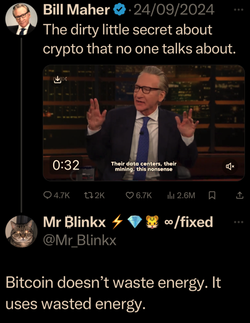
Bitcoin doesn’t waste energy. It uses wasted energy.
It is actively incentivising us to seek out and utilise vast swathes of stranded or unused energy globally. And, by building more electricity infrastructure around those sources, mankind and the environment will benefit long into the future.
Notes
- Bitcoin Doesn’t Waste Electricity, It’s Used for Security, an article outlining how electricity is the foundation of Bitcoin’s security model, Bitcoin Magazine, November 2015 https://bitcoinmagazine.com/business/bitcoin-doesn-t-waste-electricity-it-s-used-for-security-1446482572
- Bitcoin miners account for 95% of the Large Flexible Loads in Texas, The Miner Mag, February 2024. https://theminermag.com/news/2024-02-29/bitcoin-mining-map-north-america-texas/
- Lack of grid capacity pushes ‘wasted wind’ costs to £250m, Business Matters, March 2025 https://bmmagazine.co.uk/news/lack-of-grid-capacity-pushes-wasted-wind-costs-to-250m/
- Iceland: The Unlikely Bitcoin Mining Hub, Industry Leader Magazine, September 2023 https://www.industryleadersmagazine.com/iceland-the-unlikely-bitcoin-mining-hub/
- What makes methane a more potent greenhouse gas than carbon dioxide? Climate Portal, December 2023. https://climate.mit.edu/ask-mit/what-makes-methane-more-potent-greenhouse-gas-carbon-dioxide
- Bitcoin flare firm Crusoe buys rival Great American Mining, Data Center Dynamics, October 2022 https://www.datacenterdynamics.com/en/news/bitcoin-flare-firm-crusoe-buys-rival-great-american-mining/