Whoever controls the volume of money in our country is absolute master of all industry and commerce… when you realize that the entire system is very easily controlled, one way or another, by a few powerful men at the top, you will not have to be told how periods of inflation and depression originate. James A. Garfield, US President
In the previous module you learned that the financial world relies on a system that may not be as strong as it seems. The fiat system, sustained by the constant addition of new paper money, seems to benefit a few at the expense of everyone else.
This module uncovers what the fiat system means for regular people and society. Finally, we explore the story of a group of individuals who noticed these problems and quietly worked to find a solution that could change the future of human society.
4.1Money Buys Less
Monetary Inflation and Its Effect
Monetary inflation is an increase in the money supply in an economy. When more money is created, each unit of money tends to lose value, reducing purchasing power. As more money circulates, demand for the same amount of goods and services rises, which pushes prices up.
Imagine a small group of friends, Alex, Bob, and Charlie, each with one dollar, and there is one bottle of water for sale. Three people, three dollars, one bottle. Now suppose the government gives each of them an extra dollar. They now have six dollars in total. With more money, they all want to buy the same bottle, so they start competing for it.
Because of this increased demand, they begin offering more than the original price. The competition drives the price of the bottle up. Even though they have more money, each dollar buys less than before. They cannot buy as much as they could previously.
In this example, their purchasing power fell because the money supply increased. They had no control over this change. More money combined with the same amount of goods led to higher prices, making it harder to afford the same things.
This shows how purchasing power can be affected by forces outside our control and why it is important to understand how money systems work.
Activity: Auction
This is a class exercise where participants learn firsthand how the increase in money supply impacts pricing. The intent is for participants to understand monetary inflation (not price inflation).
Key Points
Prices in a free market are set by individuals' subjective values (e.g., students bidding for items).
Remember that Inflation = increase in money supply. This is the concept behind the phrase "more money chasing the same goods".
Beware of misuse of the word "inflation". Monetary inflation is not the same as price inflation. News media and central planners prefer to use price inflation measures like consumer price inflation (CPI) because it can be manipulated.
When fiat money is created, it is not distributed evenly. It flows first to those closest to the money printer (e.g., big industry players). They can unfairly purchase assets before prices rise for everyone else.
Student Tip
This activity is a participatory game. The more you invest in terms of effort and creativity, the more fun it will be … and the more effective.
You do not need fancy vocabulary, complex models or college degrees to understand economics and how money really works.
4.2The Global Debt Burden and Social Inequality
I don’t believe we shall ever have good money again until we take the thing out of the hands of government… all we can do, is by some sly, roundabout way, introduce something that they can’t stop. Friedrich Hayek, Nobel Prize Winner of Economics
Impact on Individuals — Loss of Purchasing Power
Jaime is a college student who lives in a small apartment. He works part-time at a coffee shop to pay for his living expenses and tuition. As soon as he began living independently, Jaime became good at managing his own ledger.
A ledger is a record of all your monetary transactions, including income and expenses. Whether you’re earning or spending money, a ledger helps you keep track of it.
At the beginning of 2023, he budgeted $10,000 for his living expenses for the entire year, including rent, food, and other necessities. This is how his ledger looks for January 2026:
Date
Description
Amount
Type
Balance
01/01/2026
Starting Balance
$1,600
01/01/2026
Rent for January
$800
Debit
$800
01/05/2026
Groceries
$100
Debit
$700
01/15/2026
Part-time paycheck
$500
Credit
$1,200
01/20/2026
Gas for car
$350
Debit
$850
01/30/2026
Textbooks
$150
Debit
$700
This ledger shows that Jaime’s starting balance was $1,600 out of which he spent (a debit) $800 to pay rent for the month. He then spent $100 on groceries and received $500 (a credit) in pay for his part-time job, bringing his balance to $1200. He then spent money on gas and textbooks, bringing his balance down to $700 at the end of the month.
Twelve months later, Jaime is having lunch with his grandfather with whom he shares the details of his budget for 2026. Jaime notices that his budget is not stretching as far as it used to and that his cost of living has increased significantly over the past year. While Jaime is wondering how this could be, his grandfather shows him the following image.
Jaime cannot believe his eyes. This is the moment he discovers that the cost of goods and services increase drastically over time, leading to a decrease in his purchasing power.
His grandfather says: “In 1956, I was just a young man starting out in the world. I remember that I used to earn $380 a month as a factory worker. It may not seem like much, but it was a decent wage at the time. In fact, I was able to save up enough money to buy my own house in the suburbs.”
The grandfather continues: “Prices were very different in the past century. For example, in 2020, purchasing 30 Hershey’s chocolate bars would cost you $26.14. However, back in 1913, the same number of Hershey’s bars would have only cost $1!”
This significant difference in price highlights the change in purchasing power over time and how it has decreased over the years due to inflation.
Jaime: “What? That’s crazy. I can't imagine how low my rent would have been then compared to now.”
Grandfather: “Well yes, your rent would have been much cheaper back then. I have another example to illustrate this: back then, $1 would have bought you about 10 bags of pretzels. In 2020, I paid $9.69 for the same amount. Imagine how much 10 bags of pretzels would cost today.”
Jaime: “Wow, that’s really interesting, Grandpa. How did you experience this yourself when you were younger?”
Grandfather: “Oh, Jaime, everything was just much cheaper when I was young. A loaf of bread would only cost $0.18, and you could buy a gallon of gasoline for just $0.29. It is unbelievable how much the cost of living has gone up.”
The purchasing power of the U.S. dollar has fallen sharply over the last century due to rising inflation and money supply.
After the conversation with his grandfather, Jaime goes home to take another look at his ledger. He quickly discovers that he needs to budget an additional $1,000 for 2024 to be able to buy the same basket of goods and services that he purchased in the previous year. This means that his purchasing power has decreased by $1,000 as he now has to spend more money to buy the same goods and services. While his cost of living skyrockets every year, Jaime’s salary only increases very little.
The following table shows Jaime’s costs in the first and second years, as well as the percentage increase in price.
Item
Cost Year #1
Cost Year #2
% Increase
Rent
$4,000
$4,500
12.5%
Groceries
$2,000
$2,300
15%
Necessities
$4,000
$4,200
5%
Total
$10,000
$11,000
10%
In order for Jaime to live under the same standard of living, he will need to work more hours per week in Year #2 to earn an additional $1,000.
Based on information from the US Bureau of Labor Statistics, prices today are about 30 times higher than they were in 1913. This means that a dollar today can buy only around 3% of what it could buy back then.
To illustrate, if someone from 1913 traveled in time to 2023 equipped with a $100 bill they would find that their cash only buys them the equivalent of what $3 dollars could buy them in 1913. The significant difference in value shows how much money’s purchasing power has decreased over the years.
In nominal terms (that is, thinking purely in numbers), Jaime appears to earn much more in a year than his grandfather ever did, but the dollars that Jaime’s grandfather possessed were much more valuable and could buy much more back then.
In today's world, the significant impact of inflation discourages people from saving money.
Instead, most choose to spend their money immediately because its value decreases rapidly. This pessimistic outlook hampers people’s ability to plan for the future.
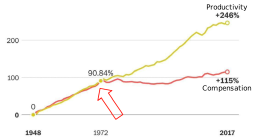
As seen in the graph, the average individual's salary growth remains stagnant for decades when adjusted for inflation, despite being much more productive. This means that all that added value due to increased productivity is being eaten up by inflation, instead of rewarding working people.
Growth in Productivity and Hourly Compensation (1948-2017). NOTE: Compensation includes wages and benefits for production and non-supervisory workers.
Jaime's example is just one among many. In the fiat world, it's quite common for governments to create money out of thin air to further their own agenda, leaving individuals worldwide to bear the consequences. The prices of everyday items, from bread to housing, and from groceries to holidays, increase each year. While the rich benefit from inflation due to owning appreciating assets, ordinary folks who save in cash see their hard-earned money lose its value. The result? People and families worldwide struggle as their purchasing power decreases.
People around the world find themselves working more jobs and longer hours just to maintain the same standard of living. It's like being on a treadmill — running faster and faster but never really getting ahead. The fiat system leaves individuals feeling like they are in a perpetual race against rising prices.
In their struggle to keep pace with increasing costs, many turn to credit, which is like using a small Band-Aid on a very deep wound. People take on loans or make impulsive decisions just to get by. Fast money becomes a necessity, and individuals find themselves in a cycle where survival today takes precedence over planning for tomorrow.
The fiat system, with its constant money printing, impacts humanity’s psychology. It instills a high time-preference — a focus on short-term gains over long-term planning. Just like a quick fix for immediate relief, individuals in the fiat world tend to prioritize short-term benefits. It is a survival instinct, but one which creates a cycle of dependency where individuals seek any means to obtain fast money, even if it is not sustainable or workable in the long run.
In essence, the impact of the fiat system paints a challenging picture for individuals globally. In the fiat system, prices rise, incomes stagnate, and the struggle to survive becomes a daily battle. While certain groups get richer, most individuals worldwide stay dependent on a system that makes them poorer and poorer.
In a society based on sound money, a government’s financial decision-making is limited to its economic capacity. In the fiat system, however, governments can issue essentially unlimited debt on the backs of their citizens. The power to print money at will often leads to political centralization. The fiat system enables governments to accumulate massive debts, making decisions that benefit themselves rather than the majority.
Superpowers like the United States gain a competitive edge due to this phenomenon. They can print money endlessly to fund their plans, including wars. This ability allows these dominant nations to control, influence, and engage in geopolitical conflicts, creating a global power imbalance. Wars and major actions to control others become financially feasible for superpowers while others without the same financial flexibility face limitations.
Under the fiat system, wealth does not distribute itself evenly. Instead, it tends to concentrate in the hands of a select few. This phenomenon is like playing a game of Monopoly where a handful of players possess almost all the hotels and properties while the majority struggle to stay afloat. The fiat system has become a wealth concentration tool for certain groups. Money printing allows governments to inject more currency into the economy through their collaboration with central banks, and the first recipients of this newly created money are those with existing wealth and status — powerful entities and individuals. These groups benefit from the freshly printed money before its negative effects, start to manifest in the economy.
Wealth inequality is not just about the haves and have-nots; it is about suppressing economic mobility. Those from less privileged backgrounds find it increasingly challenging to climb the economic ladder, akin to starting a race with a heavy backpack. Then the wealthy use their influence to skew government policy in their favor, increasing the gap further. This makes things harder for regular people, leading to social unrest, a lack of trust in institutions, and communities falling apart like a house of cards. The fiat system's instability manifests in economic uncertainty, political unrest, and global crises when the Western world faces an economic downturn.
Under the fiat system, debt has become the norm for humanity. Governments, institutions, businesses, and individuals worldwide find themselves immersed in a sea of debt.
The psychological shift toward considering debt acceptable has its roots in the fiat system's design. During the past several decades, it has become easier and easier for entities to take on substantial debt, and it often becomes a necessity for ordinary people due to rising prices.
The constant and rapid depreciation of fiat money leads to consumerism, the constant urge to buy and consume whereby people purchase more than they need, resulting in overconsumption and waste. While it may seem like a never-ending shopping spree, the real cost goes beyond the price tag, impacting people’s psychology and well-being.
It becomes clear that the fiat system is not just an economic mechanism. Rather, it is a system that shapes human society as a whole. From the concentration of power to global dynamics, wealth disparities, and societal norms, the fiat system directly influences how nations operate and how regular citizens navigate their lives.
The Global Debt Burden
As a result of the fiat system, governments around the world are trapped in a growing web of debt, often called the “global debt spiral.” Imagine borrowing more than you could ever repay. This is happening at a massive scale. Governments continue to take on more debt than they can handle, driven by ongoing spending, borrowing, and short-term thinking, pushing many nations closer to financial instability.
As of today, the U.S. federal government has added about $13 trillion in new debt since 2019. Total debt has risen from roughly $23 trillion in late 2019 to around $37 trillion today. Governments worldwide are not slowing down their borrowing. In fact, it is increasing, with 2023 projected to be one of the highest debt-adding years since 2021 during the COVID pandemic.
So what does this mean for individuals and societies already dealing with the effects of the fiat system? The debt spiral is like a snowball rolling downhill, growing larger over time, with little political will to stop it.
The consequences, from rising inequality to social unrest, are unlikely to disappear. Instead, the global debt burden continues to grow, making future conditions increasingly difficult.
Discussion: Consequences of the Fiat System
Are there any other consequences that individuals and society as a whole experience as a result of the fiat system?
What are the consequences of the fiat system in your country? What has happened throughout history? How did that affect the people in your country?
Personal examples: interactive session
4.3The Quest for a Decentralized Currency
We have observed the progressive capture of money by banks and governments throughout history, leading to the fiat system we know today and its disastrous consequences for society. But the rise of new technologies like encryption and the internet have allowed new ideas to emerge, such as independent digital money — free of government intervention, open and accessible to all. Let's dive into the journey of those leading this revolutionary movement: the Cypherpunks.
The Cypherpunks
The computer can be used as a tool to liberate and protect people, rather than to control them. Hal Finney
The second half of the 20th century saw the rise of powerful new technologies like personal computers and the internet. These innovations began to change how people communicate, share information, and organize society.
Some thinkers and programmers realized that these technologies could either increase individual freedom or allow governments and corporations to monitor and control people more easily.
This group became known as the Cypherpunks. They believed that cryptography, the use of mathematical code to secure information, could protect individual freedom in the digital age.
Cypherpunks worked on tools that could protect privacy online, secure communications, and allow people to interact on the internet without relying on centralized authorities.
One of their key goals was to create a form of digital money that people could use without banks or governments controlling it. Bitcoin was later created as a solution to this problem.
Orwellian future refers to a dystopian society where a powerful authority, usually the government, closely controls people’s lives. In such a world, citizens are constantly watched, information is manipulated, and speaking against those in power can lead to punishment. Personal freedoms are limited, and the truth is often distorted to maintain control.
Key figures in the Cypherpunk movement included Eric Hughes, Timothy C. May, and John Gilmore. In 1992, Eric Hughes wrote A Cypherpunk Manifesto, which argued that people should have the right to privacy and control over their digital lives.
Cypherpunks believed cryptography could protect individuals online. In 1991, Phil Zimmermann created PGP (Pretty Good Privacy), a tool that allowed people to send encrypted emails so that only the intended recipient could read them.
They believed encryption, combined with the internet and computers, could allow people to communicate and interact online without relying on central authorities.
However, one major problem remained unsolved: the world still lacked a decentralized digital currency that people could use freely on the internet.
Centralized vs Decentralized Systems
Centralized Systems
In a centralized system, everything revolves around one main authority, like a tall building in a city. This authority controls how the entire system works. Think of traditional banks as an example, where a small group makes all the decisions.
Problems with Centralized Systems
Central point of failure: If something goes wrong with the central authority, the whole system can collapse.
Control: A small group at the top has all the control and power, often resulting in decisions that benefit them rather than everyone else.
Inefficiency and intermediaries: Like traffic jams in a city, centralized systems can become slow and expensive because of unnecessary middlemen.
Lack of autonomy: People might not get to make their own financial choices; it's all decided by the top authority.
Censorship and restriction: Just like some parts of a city can be blocked off, centralized systems may block or limit access to certain financial resources.
Scaling challenges: When more people need financial services, centralized systems may struggle to keep up.
Security risks: Problems with the central authority can put the whole system at risk of cyberattacks.
Lack of transparency and trust: The inner workings of centralized systems can be hard to understand, making it tough for people to trust them.
In 2022, during peaceful protests in Canada, banks froze protestors' accounts, showing how a central authority could control financial access.
Decentralized Systems
Think of a decentralized system like a forest. Each tree is a separate part, and the whole forest is the system. Unlike a city with one central point, a decentralized system is more resilient and can keep going even if one part fails.
Benefits of Decentralized Systems
Enhanced resilience and reliability: There is no single point of failure, which makes the system strong, even when issues appear.
Increased security: With the right encryption/protection, a decentralized system is better at resisting control from a single authority.
Greater Sovereignty: People have more control over their money, data, and choices.
Improved transparency: Everyone sees the same information, making the system more trustworthy.
Permissionless and limitless: Anyone can join or take part.
Equal opportunities: Everyone has a fair chance to contribute and have a say.
Enhanced Privacy: Data is distributed across multiple participants and mostly pseudonymous, making decentralized systems more private.
While decentralized systems have lots of advantages, making decisions together can be a bit tricky. It requires everyone to work together.
In a world of centralized and decentralized systems, it's all about who holds the power. Centralized systems give power to a small group, while decentralized systems spread it out, letting everyone have a say. This shift in power would mean a fairer future, where many people influence the system that shapes their lives.
The Tor Network create a decentralized system where people can stay anonymous online and the network is hard to stop or censor.
Brief History of Digital Currencies
One of the key ideas discussed by the Cypherpunks was digital cash. They believed money should be separated from government so people could send and receive payments freely and privately online.
Early cryptographer David Chaum created one of the first systems for digital cash using cryptography to make transactions secure and private. However, his system still relied on a central authority to operate, which meant it could fail or censor transactions.
Over the following decades, many Cypherpunks tried to design a form of digital money that did not depend on a central authority. While they introduced important innovations, none of their systems solved all the challenges needed for a secure, decentralized, and widely usable digital currency.
These attempts helped reveal what was missing. Later, someone built on these ideas and finally created a working system for decentralized digital currency.
Resources
Cypherpunks Write Code
Watch this video and discover the story of the Cypherpunks!